The case for Thorium 20. China is having a massive Thorium program.

China is having a massive Thorium program. The People’s Republic of China has initiated a research and development project in thorium molten-salt reactor technology. The thorium MSR efforts aims not only to develop the technology but to secure intellectual property rights to its implementation. This may be one of the reasons that the Chinese have not joined the international Gen-IV effort for MSR development, since part of that involves technology exchange. Neither the US nor Russia have joined the MSR Gen-IV effort either.
China is currently the largest emitter of CO2 and air pollutants by far, and according to the Paris accord was allowed to emit six times as much pollutants as the U.S. by 2030, being a “developing nation”. Their air quality is already among the worst in the world so something had to be done if they were to achieve world dominance by 2025 and total rule by 2030. Only Thorium can solve the pollution problem and provide the clean energy needed for the future. Regular Uranium Nuclear reactors require large amounts of water and Molten Salt Thorium reactors require little water to operate.

Geneva, Switzerland, 21 August 2018 – As the world struggles with a record-breaking heatwave, China correctly places its trust in the fuel Thorium and the Thorium Molten Salt Reactor (TMSR) as the backbone of its nation’s plan to become a clean and cheap energy powerhouse.
​​The question is if China will manage to build a homegrown mega export industry, or will others have capacity and will to catch up?
For China, clean energy development and implementation is a test for the state’s ability. Therefore, China is developing the capability to use the “forgotten fuel” thorium, which could begin a new era of nuclear power.​
The first energy system they are building is a solid fuel molten salt reactor that achieves high temperatures to maximize efficiency of combined heat and power generation applications.
However, to fully realize thorium’s energy potential and in this way solve an important mission for China – the security of fuel supply – requires also the thorium itself to be fluid. This is optimized in the Thorium Molten Salt Reactor (TMSR).
The TMSR takes safety to an entirely new level and can be made cheap and small since it operates at atmospheric pressure, one of its many advantages. Thanks to its flexible cooling options it can basically be used anywhere, be it a desert, a town or at sea. In China this is of special interest inland, where freshwater is scarce in large areas, providing a unique way to secure energy independence.
“Everyone in the field is extremely impressed with how China saw the potential, grabbed the opportunity and is now running faster than everyone else developing this futuristic energy source China and the entire world is in a great need of.”
– Andreas Norlin, Thorium Energy World
Picture
China is not telling all they are doing on Nuclear Energy.

The case for Thorium 13. Virtually no spent fuel problem, very little on site storage or transport.

 Virtually no spent fuel problem, very little on site storage or transport. I have been following the events at Fukushima Nuclear Power plants disaster with great interest. How ironic that one of the greatest problems was with the spent fuel, not with the inability to shut down the working units. The spent fuel issue is the real Achilles’ heel of the Nuclear Power Industry. The cost of reprocessing and storing spent reactor fuel will burden us for centuries after the reactors themselves have been decommissioned after their useful life. Molten Salt Thorium nuclear power works differently from  conventional Uranium fueled Reactors as  the fissile fuel gets generated in the breeding process itself and nearly all fuel gets consumed as it is generated. When the process shuts down, that is it. Only the radioactivity that is en route so to say will have to be accounted for, not everything generated thus far in the process. The difference is about ten thousand to one in the size of the problem. It is high time to rebuild and expand our Nuclear power generation by switching to Thorium.

The case for Thorium. 11. Molten Salt Nuclear Reactors have a very high negative temperature coefficient leading to a safe and stable control.

Molten Salt Nuclear Reactors have a very high negative temperature coefficient leading to a safe and stable control. This is another beauty of the molten salt design. The temperature coefficient is highly negative, leading to a safe design enabling simple and consistent feedback. What does that mean?  It means that when the temperature of the fissile core rises, the efficiency of the reaction goes down, leading to less heat generated. There is no risk for a thermal runaway. In contrast,  graphite moderated generators can have a positive temperature coefficient which leads to complicated control, necessitating many safety circuits to ensure proper startup, operation and shutdown. Their worst failure mode is they go prompt critical, and no containment vessel can contain the explosion that would occur, so they were built without one. There have been several major accidents in graphite moderated reactors, with the Windscale fire and the Chernobyl disaster probably the best known.

The case for Thorium. 6. Radioactive waste from an Liquid Fluoride Thorium Reactor decays down to background radiation in 300 years compared to a million years for U-235 based reactors. A Limerick.

The nuclear waste meant for Yucca

would destine Nevada the sucka

But with Thorium we rid

us of waste that is hid

No need for that waste to be trucka!

Radioactive waste from an LFTR (Liquid Fluoride Thorium Reactor)  decays down to background radiation in 300 years instead of a million years for U-235 based reactors. Initially LFTRs produce as much radioactivity as an U-235 based nuclear reactor, since fission converts mass to heat, but the decay products have a much shorter half-life. See the figure below.

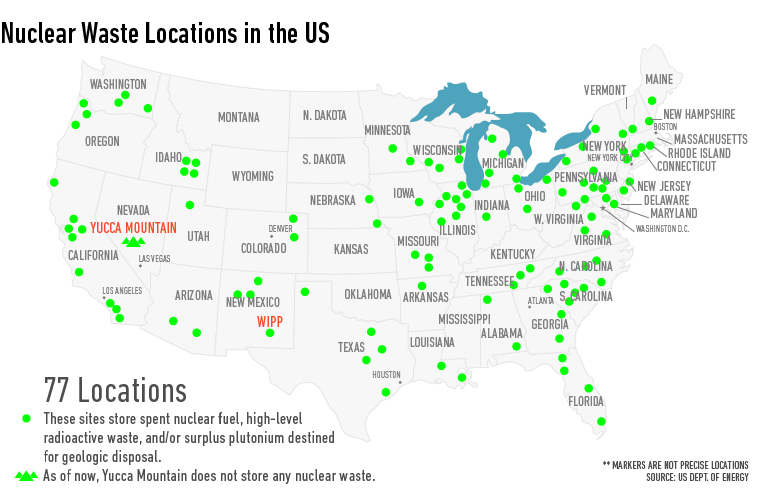
Where is the storage for spent nuclear fuel and other nuclear waste now? Look at the map, it is scary.


And these are just the U.S. installations!

Many years ago I studied Engineering at Chalmers’ University in Sweden and I thought I would become a nuclear engineer. Sweden had at that time a peaceful heavy water based nuclear power program together with Canada and India. The advantage with heavy water as moderator is that it can use natural, un-enriched Uranium. One of the end products is of course Plutonium 239, the preferred material to make nuclear bombs, but it could also use Thorium, and the end product is then mostly Plutonium 238, used in space exploration, and we were dreaming big. One of the advantages of Thorium as fuel is that it produces about 0,01%  of trans-Uranium waste compared to Uranium as fuel. About that time the U.S. proposed we should abandon the heavy water program and switch to light water enriched Uranium based nuclear power. They would sell the enriched Uranium, and reprocess the spent fuel at cost. They also had the ideal final resting place for the radioactive waste products in Nevada. This was an offer the Swedish government could not refuse, at the height of the cold war. This was  in the 1960’s! India on the other hand did refuse, and they eventually got the nuclear bomb. Since that meant Sweden was never going to use Thorium as nuclear fuel, and I could not figure out how to get rid of all the radioactive waste products, I switched my attention back to control engineering.


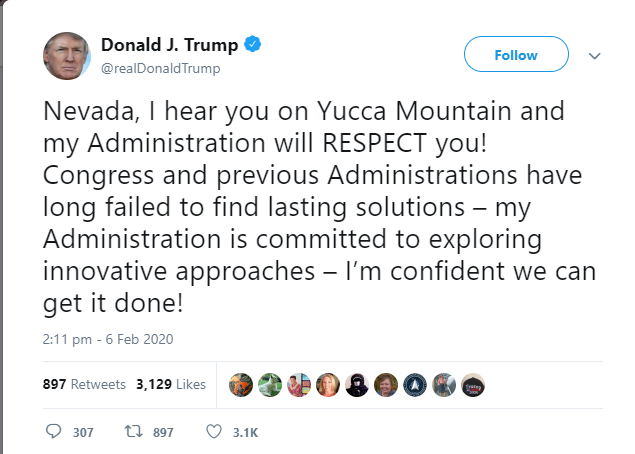
What did President Trump mean with innovative approaches?

Is this where Thorium comes in!?

Penn State University Engineering Capstone Showcase 2018.

Thursday, two days before finals was the PSU Engineering Capstone showcase. Even though I have been a lecturer there for the last six years I didn’t realize it is by far the largest Capstone showcase of this type in the world, and it is growing year by year. This year there were over 200 teams competing, mostly graduating seniors, but a good number of freshmen in engineering, and not a few graduate projects, in all over 1000 participants.

The set-up began at 10:30 a. m. in the Bryce Jordan main Arena, with 139 senior Capstone projects displaying their projects.

The overflow training area had over 70 projects from Civil Engineering and Earth Science, Nuclear Engineering, as well as graduate projects and the displays from the freshman Engineering Design course.

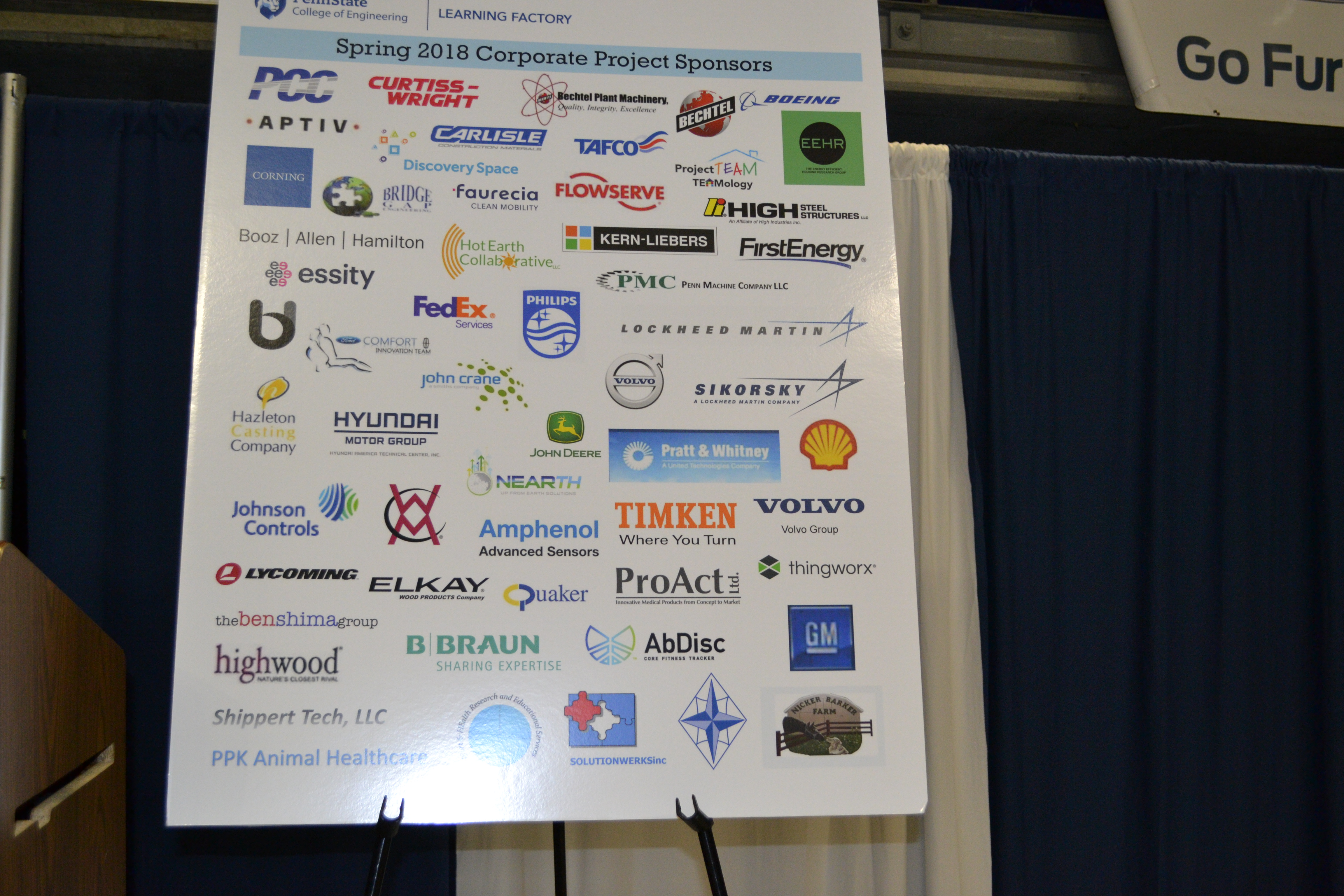
The success of the showcase is in part because of a large number of corporate sponsors, many who sponsor multiple projects. Some of these projects are the very cutting edge of  science, and provide a real challenge for the students.

My role as an instructor is quite simple: To convert the engineering students from students to world class engineers in 17 short weeks. The engineering students are organized in teams of 4 or 5 persons. Most of the teams consist of engineers from more than 2 disciplines. So the teams must get to know each other, work together as a functioning team, do the research, build a prototype or a final product as a team, with deadlines to meet. This is quite different from cramming for an exam.

The projects are quite different:

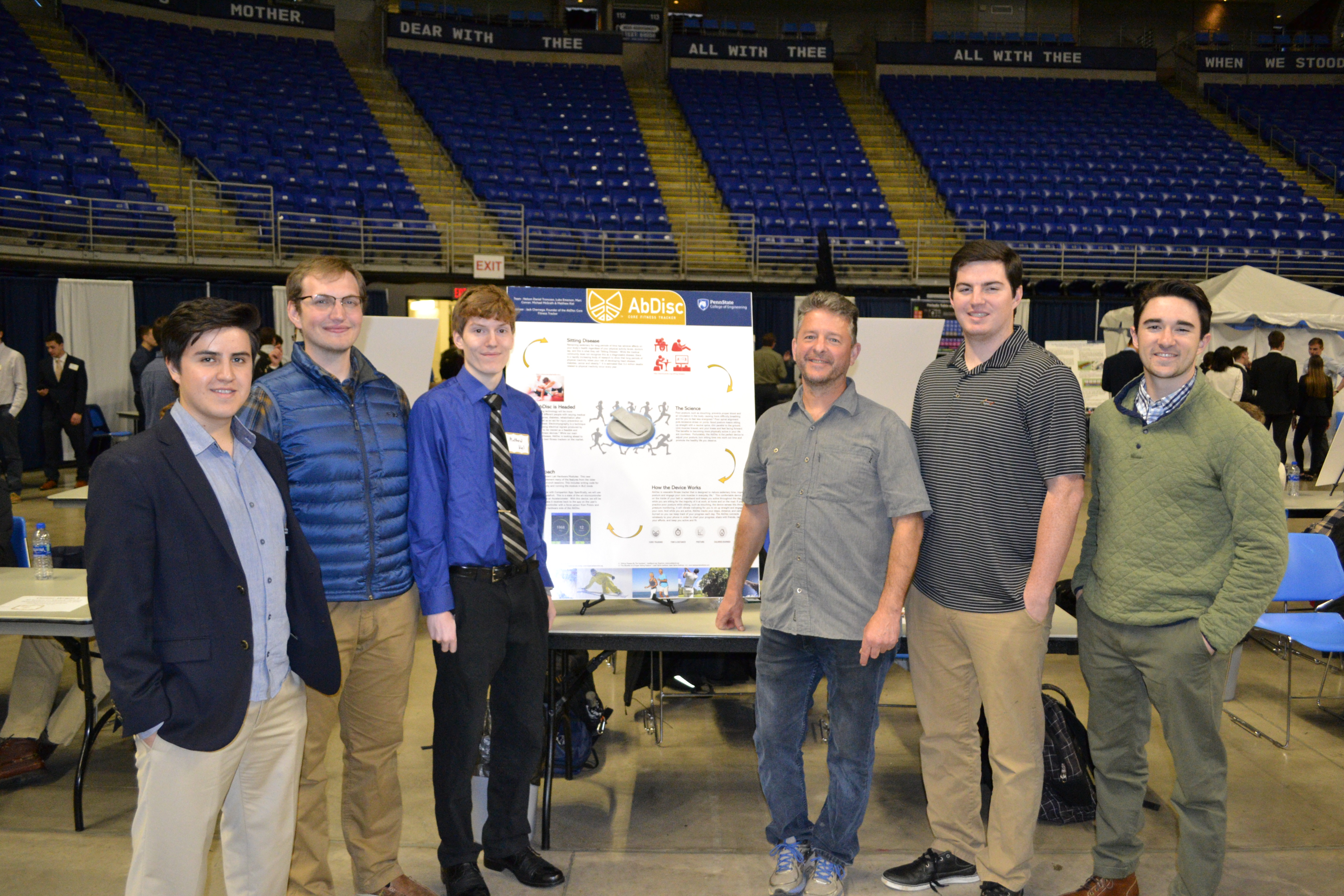
Here is a project to build a prototype fit-bit that monitors the total activity and inactivity of a subject.

Next is a happy team that made a LED light that can adjust the color and saturation of light and modulate upon command.

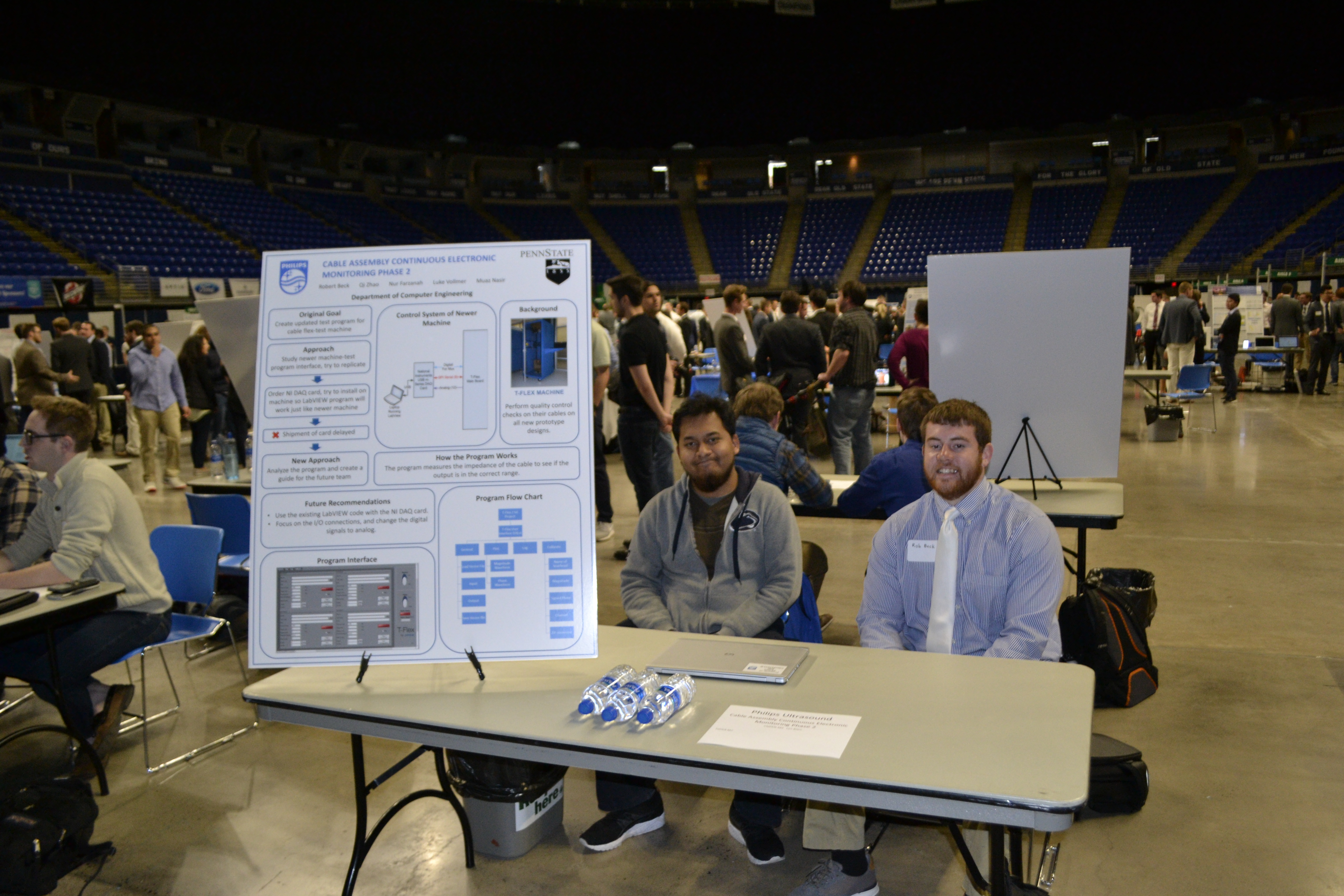
Not all projects are innovative. This project from Philips ultrasound division involved upgrading an old impedance measuring device to function with the newest hardware and software, in short a project that many computer engineers will experience; what to do with legacy hardware and software.

Next was a project to utilize the internet of things.


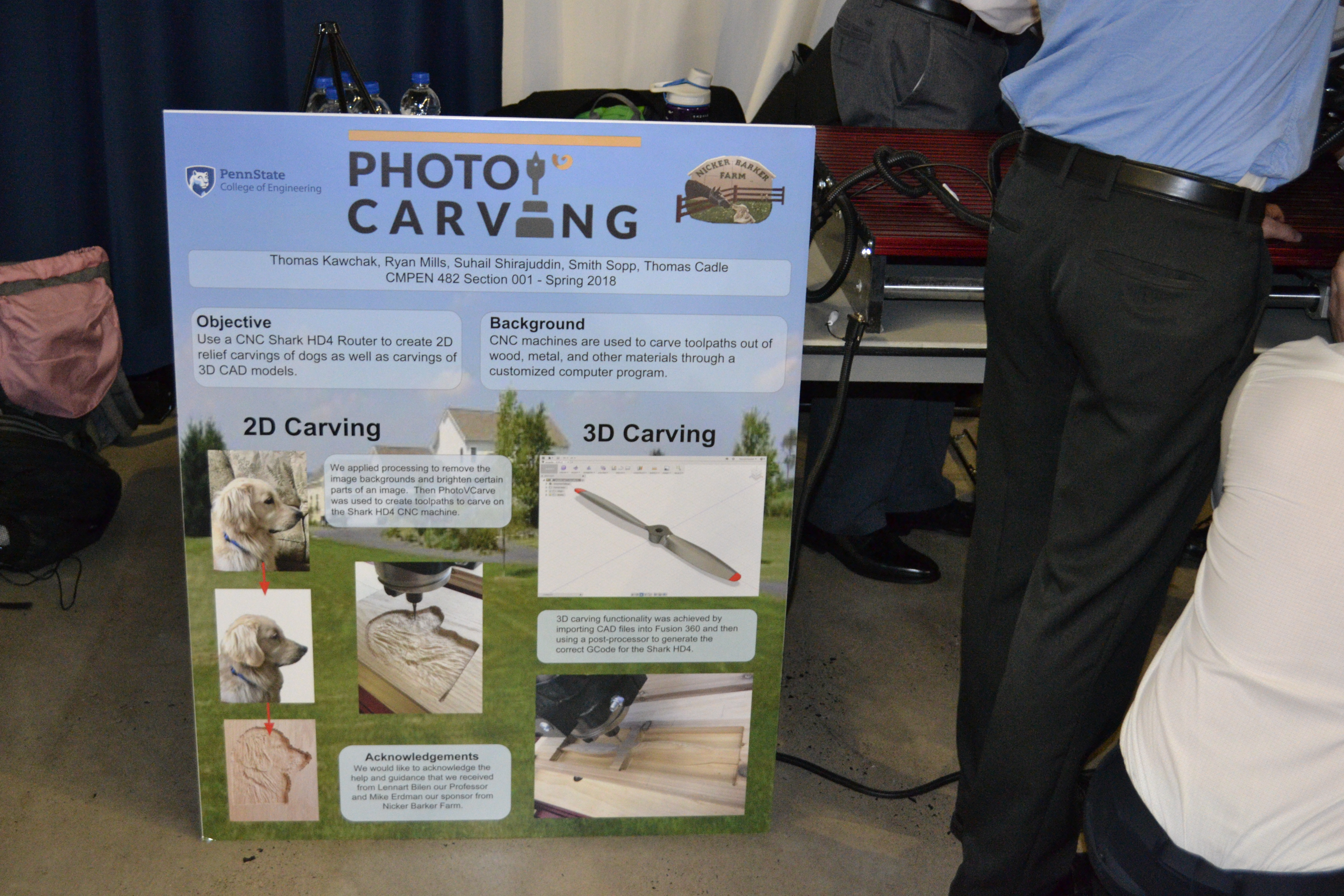
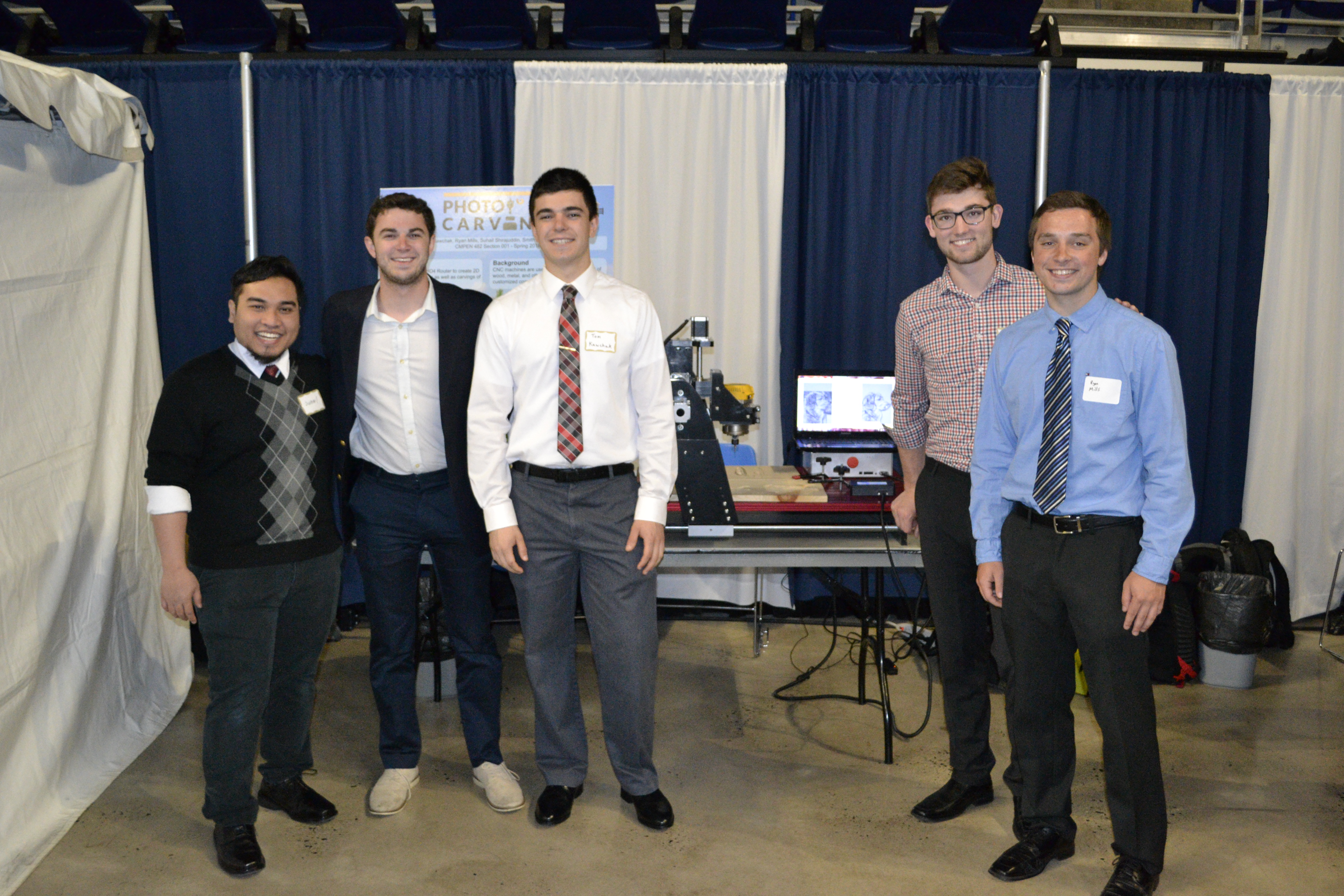
This project was interesting: Modify existing wood carving software to get a realistic wood carving of a dog from a photo.

They certainly seem happy!

My favorite project this year was to use a hololens to make an image of a liver projected in 3D in the hololens. The object was to help the surgeon by identifying nerves and vessels to improve the accuracy of surgery.

At 3 o’clock it was time for the presentation of the awards. Free Creamery ice cream for everyone!

Another successful Showcase at Penn State University, making yet another batch of world class engineers. Yes, they come from all over the world, one of my teams only had one American!