With a Molten Salt Reactor, accidents like Chernobyl are impossible. The Three Mile Island accident was bad. The Chernobyl disaster was ten million times worse. Ah yes, I remember it well.
One morning at work, a fellow co-worker, a Ph.D. Chemist working on an Electron Capture Detector, containing a small amount of Nickel 63, came with a surprising question: You know nuclear science, how come the reactors in Chernobyl don’t have a containment vessel? Well- I answered, it is because they are carbon moderated and their failure mode is that they go prompt critical, and no containment vessel in the world can hold it in, so they skip it. He turned away in disgust. A few weeks later my wife’s father died, and we went to Denmark to attend the funeral. The day of the return back to the U.S. we heard that there had been a nuclear incident in Sweden, too much radiation had caused two nuclear power stations to close down. The Chernobyl disaster had happened 26 April 1986, and this was the first time anyone outside of Chernobyl has heard about it, two days later. This was still the Soviet Union, and nothing ever did go wrong in it worthy of reporting.
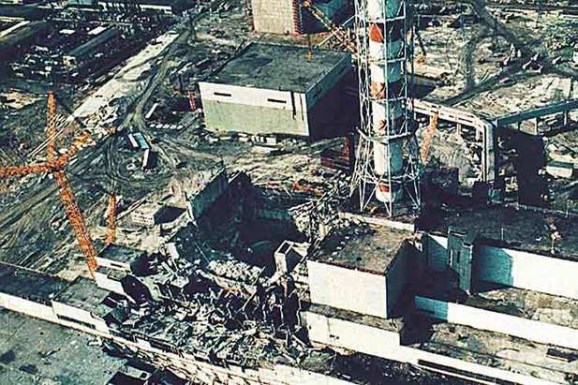
(Photo Courtesy of EBRD)
Notice the gaping hole where the reactor was. The adjacent reactor was not shut down immediately, but continued to operate and deliver power for days. During the invasion of Ukraine in 2022, the still-very-real health risks inherent to lingering around certain parts of the Chernobyl Exclusion Zone just didn’t sink in with Russian soldiers and their commanding officers based in Belarus. Radiation sunk in, though—particularly after Russian troops dug into the zone’s heavily irradiated Red Forest. And today, some soldiers are still falling sick, according to diplomatic sources cited by the UK journal The Independent.
The radiation cloud immediately following the accident continued to spread, and was first noticed in Sweden, and the SLV immediately declared reindeer meat, wild game and inland fish with a 300-bequerel/kilogram (Bq/kg) count or higher to be unsafe for human consumption and therefore unmarketable. 75% of all reindeer meat was deemed unfit for human consumption, and this played havoc with the Sami population.
(But the carbon moderated Uranium reactors are the most efficient in producing Pu-239 the preferred nuclear bomb material.)
As I mentioned before, the failure mode of carbon moderated nuclear power plants is that they can go prompt critical during power downs, so very stringent power down protocols must be followed. There is a loss of power production during the lengthy power down process. Carbon moderated nuclear power plants has a positive temperature coefficient; the warmer it gets the more power it produces, so they must be provided with multiple safety circuits and infallible scram shutdowns. However, power shutdowns are costly, so they try to stretch the shutdown intervals as much as possible. In the case of Chernobyl, the protocols were violated for political reasons, one or more safety circuits were disabled to allow power production for as long as possible and suddenly there was a power surge, the temperature surged and the chain reaction started. The scram rods failed and the rest is history.
This has nothing to do with anything, but Chernobyl means wormwood in Russian. It is mentioned in the Bible, Revelation 8: 10-11 “ And the third angel sounded, and there fell a great star from heaven, burning as it were a lamp, and it fell upon the third part of the rivers, and upon the fountains of waters; And the name of the star is called Wormwood: and the third part of the waters became wormwood; and many men died of the waters, because they were made bitter. ”
Molten Salt Thorium reactors cannot be used to supply Plutonium 239, only Uranium 233, and so far there is no research on how to make bombs from U 233, and they are far safer than even Light water Uranium reactors. Only gravity is needed to shut them down in case of earthquakes, total power failures, EMP pulses and bombs.
 Len Bilén's blog, a blog about faith, politics and the environment.