July 5, read through the Bible in a year.

Today we read one chapter of second Corinthians  and finishing up Ezra.

July 5: 2 Corinthians 2, Ezra 8, Ezra 9, Ezra 10 (click on the chapter to begin reading)

2 Corinthians 2, No more Sorrowful, Forgive the Offender, Triumph in Christ.

Ezra 8 starts with a list of the heads of families who returned with Ezra. Ezra separated twelve priests to be temple servants and led in fasting and prayer for protection.  The people came with gifts for the temple as they returned to Jerusalem.

Ezra 9. Ezra prayed about iIntermarriage with pagans and called it a sin according to the Law.

Ezra 10. The returning exiles made confession of improper marriages, and their pagan wives were put away.

July 4, read through the Bible in a year.

Today we read the first chapter of second Corinthians  and three chapters of Ezra.

July 4: 2 Corinthians 1, Ezra 5, Ezra 6, Ezra 7 (click on the chapter to begin reading)

2 Corinthians 1. After Paul’s customary greeting he gives praise to the God of all comfort, which includes comfort in suffering and consolation from suffering. Paul tells of his sincerity and his change of plans and God sparing the Church.

Ezra 5. The restoration of the Temple was resumed.

Ezra 6 records the Decree of Darius and the Temple’s completion and dedication, after which the Passover was celebrated.

Ezra 7. Finally the arrival of Ezra and the letter from Artaxerxes to Ezra is recorded .

July 3, read through the Bible in a year.

In between first and second Corinthians we read two Psalms and two chapters of Ezra.

July 3: Psalm 51, Psalm 52, Ezra 3, Ezra 4 (click on the chapter to begin reading)

Psalm 51, of David, written after Nathan confronted David after his adultery with Bathsheba. This Psalm explains fully, how God would say, after David was pointed out to be both an adulterer and a murderer: “He was a man after God’s own heart”.

Psalm 52, Of David. The Psalm is a contemplation of David, contrasting the final end of evil men with the rewards of the righteous.

Ezra 3. Worship was restored in Jerusalem and the restoration of the Temple began.

Ezra 4. There arouse resistance to building the Temple and the rebuilding of Jerusalem was successfully opposed (for a while).


July 2, read through the Bible in a year.

In between first and second Corinthians we read two Psalms and the first two chapters of Ezra.

July 2: Psalm 49, Psalm 50, Ezra 1, Ezra 2 (click on the chapter to begin reading)

Psalm 49, of the Sons of Korah. This psalm is more of a teaching Psalm and gives instruction on how to live and hope of salvation “But God will redeem my soul from the power of the grave, For He shall receive me

Psalm 50, of Asaph. God says “for every animal of the forest is mine,
    and the cattle on a thousand hills.” andSacrifice thank offerings to God,
    fulfill your vows to the Most High,
     and call on me in the day of trouble;
    I will deliver you, and you will honor me.

Ezra 1 begins with the end of the Babylonian captivity and Cyrus decree to rebuild the Temple.

Ezra 2 lists the captives who returned to Jerusalem.


July 1, read through the Bible in a year.

In between first and second Corinthians we read one chapter of Proverbs and the last two chapters of second Chronicles.

July 1: Proverbs 8 2 Chronicles 35, 2 Chronicles 36 (click on the chapter to begin reading)

Proverbs 8 praises the excellence of Wisdom.

2 Chronicles 35. Josiah celebrated Passover lavishly but after that he foolishly engaged king Neco of Egypt, who was to fight somebody else. The result is that Josiah died in battle. The Prophet Jeremiah mourned and wrote Lamentations.

2 Chronicles 36 tells a sad story,  the reign and captivity of Jehoahaz,  Jehoiakim and Jehoiachin.  Zedekiah was granted king by Nebudchadnezzar but rebelled. This led to the fall of Jerusalem and seventy years of captivity. Chronicles ends with Cyrus’ Proclamation.

June 30, read through the Bible in a year.

In between first and second Corinthians we read three Psalms and two chapters in second Chronicles.

June 30: Psalm 46, Psalm 47, Psalm 48, 2 Chronicles 33, 2 Chronicles 34 (click on the chapter to begin reading)

Psalm 46, of the Sons of Korah. “Let us sing the forty-sixth psalm in concert; and then let the devil do his worst.” (Martin Luther)

Psalm 47, of the Sons of Korah. “Sing praises to God, sing praises“.

Psalm 48, of the Sons of Korah. “Great is the LORD, and greatly to be praised.”

2 Chronicles 33. Manasseh king of Judah became a sorcerer, repented and was restored but eventually died and was replaced  by Amon , who reigned for two years, did evil, was killed and his son Josiah became king.

2 Chronicles 34. When Josiah was king of Judah Hilkiah the priest found the Book of the Law. With that Josiah restored the temple and the temple worship and the people followed as long as Josiah lived.


June 29, read through the Bible in a year.

In between first and second Corinthians we read one Psalm and two chapters in second Chronicles.

June 29: Psalm 45, 2 Chronicles 31, 2 Chronicles 32 (click on the chapter to begin reading)

Psalm 45, of the Sons of Korah, a Wedding Song. C.S. Lewis saw this psalm pointing to Christmas: “The birth of Christ is the arrival of the great warrior and the great king. Also of the Lover, the Bridegroom, whose beauty surpasses that of man. But not only the Bridegroom as the lover, the desired; the Bridegroom also who makes fruitful, the Father of children still to be begotten and born.” (C.S. Lewis, cited in Willem VanGemeren)

2 Chronicles 31 tells of the Reforms of Hezekiah. “He did it with all his heart, and prospered.

2 Chronicles 32. Sennacherib boasted against the LORD but was  defeated and died. Hezekiah humbled himself,so the LORD sent an angel to deliver Judah. Hezekiah grew in wealth and honor, but he too finally died.


Climate emergency? Pray tell why. The climate change has never been better since the end of the ice age.

New York City and seventeen other U.S.Cities has just  joined 650  cities worldwide in declaring a climate emergency. We may have environmental and ecological disasters such as urban asphalt jungles where lots of people live and suffer, erosion and using up the aquifers, but climate disaster, no, not if you live closer to nature and can observe the temperature controller it provides in the forming  and disappearing of clouds.

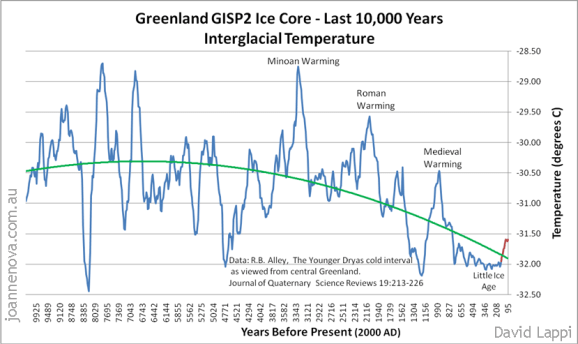
Many years ago the earth was in an ice age and the CO2 level was around 180 ppm, barely sustaining plant life. The ice age ended, most of the ice melted, and the CO2 level rose to around 260 ppm. The oceans warmed up, the humidity increased, more clouds formed and the temperature rise stopped and has been on a slow cooling trend since then. The Greenland ice cores give a good record:
Greenlandgisp-last-10000-new

All this time the CO2 level was fairly constant at around 260 ppm. This time is different; CO2 levels are now over 400 ppm, rising about 2 ppm per year with no end in sight. The question is: Is it good or bad? If it is bad, how bad is it going to be?

To answer this question the world spends over 400 billion dollars a year in climate research and are starting to spend much more in climate remediation. Over 30 nations are making climate models trying to predict future temperature trends. Of the models so far all but one fail miserably when compared to what actually is happening. The sole exception is the Russian model which tries to fit the model to past temperature records rather than postulate that response from CO2 and water vapor are always additive.

There is a better, far simpler way to predict future temperature trends. The reason CO2 and water vapor are not always additive is because water vapor is a condensing gas, sometimes forming clouds, which drastically alter the temperature of the surface. Clouds forming at day reflects a large portion of the sunlight back into space, clouds at night keep the heat in.

Willis Eschenbach has made en excellent analysis of 19 years of data from CERES (Clouds and the Earth’s Radiant Energy System from NASA). He compensates for the effect of Advection (horizontal heat transfer of energy from one place on earth to another.) The results are startling:

The 3.7 W/m2 is the expected increase of heat retention for a doubling of CO2 as per IPCC  (the U.N  Intergovernmental Panel on Climate Change). A similar result is obtained if one is to include data from HadCRUT (Temperature data from the Hadley Centre of the UK Met Office)

Tis agrees very well with my own, much coarser examination of data, but sould include that the expected temperature increase observed for a doubling of CO2 is by no means evenly distributed. In addition, if temperature rises 0,39C there will be  about 2.6 % more water vapor in the air which would rise temperature another 0.35 C. This too is not evenly distributed. Here are the expected result:

In the tropical doldrums there will be no change at all, the water vapor is all dominant and thunderstorms keep the average temperature constant.

In the 10-40 latitude there will be an increase, but increased clouds will moderate the increase except in the most arid deserts that will carry the full 0.9 C increase.

The temperate regions will experience about a 0.4 C increase in the wet areas, and about a 0.6 C in the arid parts.

Most of the increase will be experienced around the poles, with minimum temperatures rising five to ten degrees, but maximum temperatures staying about the same.

Why is that? With on the average 2.6 % increase in water vapor there will be an increase in the rainfall, about 2.6% on average, but since there is no change in the tropics it will be concentrated at the higher latitudes, especially around the poles where it will manifest itself as more snow, and that is the main reason for the increased minimum temperatures.

So, how bad is it going to get if nothing is done to stop the increase in CO2?

The temperature difference between poles and equator will be less, which means:

Fewer and less severe hurricanes, less severe tornadoes, less severe winter storms, less droughts.

But there will be about 2% more average cloud cover, more rain and more flooding.

So, with an 0.4C average temperature we will not even be back to the medieval warm period, much less the Roman warm period, not to speak of the Minoan warm period.

The sinking eastern seaboard is a problem that has very little to do with ocean rising, and all to do with tectonic plates movements, which we will have to accept.

Will anything good come out of this climate change?

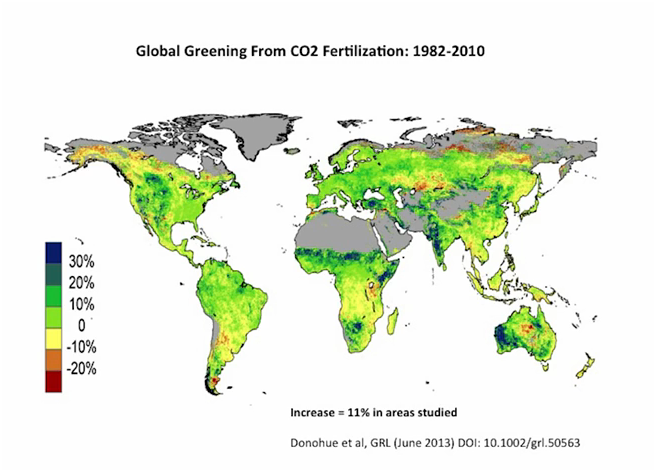
Yes, indeed. With a doubling of CO2 there will be a corresponding response from plant life increasing biological productivity 30 to 60%. It is not linear, and above 800 ppm it tapers of for most plant species. But we will be able to feed at least another 3 billion people and keep them from hunger, but also much cattle and wild animals, (yes that includes flies and gnats, but I digress)
https://lenbilen.com/wp-content/uploads/2016/11/increase.png?w=660

This picture gives us hope for the future. Notice the most significant increase was in Sub-Saharan Africa and eastern India.


June 28, read through the Bible in a year.

Today, we are reading  the last chapter of 1 Corinthians and two chapters in second Chronicles.

June 28: 1 Corinthians 16, 2 Chronicles 29, 2 Chronicles 30 (click on the chapter to begin reading)

1 Corinthians 16, Paul urged the believers to take up collections for the saints in Jerusalem. He mentioned personal lans, gave final exhortations, final greetings and farewell.

2 Chronicles 29. Hezekiah became king of Judah, he cleansed the Temple and restored temple worship.

2 Chronicles 30, Hezekiah celebrated the Passover and there was great joy in Jerusalem.

June 27, read through the Bible in a year.

Today, we are reading  one chapter of 1 Corinthians and two chapters in second Chronicles.

June 27: 1 Corinthians 15, 2 Chronicles 27, 2 Chronicles 28 (click on the chapter to begin reading)

1 Corinthians 15  speaks of the risen Christ: Faith’s reality, the risen Christ: Our hope, the last enemy destroyed, the error of denying the resurrection, the glorious body and our final victory!

2 Chronicles 27. Jotham, king of Judah followed God, became mighty, reigned sixteen years and died.

2 Chronicles 28. Ahaz, king of Judah did not follow God, was defeated by Syria and Israel. Israel returned the captives taken. After Ahaz committed apostasy, shut down the temple and died.