Yesterday the word was “the heavenly realms” found 5 times in Ephesians. The King James translation renders this “heavenly places” suggesting it is a physical location. The original Greek does not mention realms or places, it simply calls it “the heavenlies”. For we, created in time and space, have a hard time getting hold of God, after all he exists since creation of both time and space. Just think, without physical matter time and space has no meaning. The apostle Matthew calls the heavenlies the Kingdom of heaven, Mark and Luke calls it the Kingdom of God. Jesus himself says in John 18:36 “My kingdom is not of this world: if my kingdom were of this world, then would my servants fight, that I should not be delivered to the Jews: but now is my kingdom not from hence.“
We tend to think that what we do makes a difference. God has given us access to the spiritual dimension, or realm, or even place in the form of the Holy Spirit, and thanks to that He has given us power. No, he has given us access to the heavenlies, not in our selves but it is Christ, in the form of the Holy Spirit that lives in us. Without him we can do nothing.
Something happened to us today that has never happened to us before. After a successful shopping trip we went to a diner that serves excellent crab cakes. After finishing the meal, the server, followed by the manager, came and said, somebody paid for our meal. At first we were dumbfounded, we have heard of acts of random kindness, but why us, we don’t look that destitute, as a matter of fact, we look rather good, considering our age. We humbly thanked the server and manager for the anonymous generosity. Leaving the diner I remembered that we always pray before the meal, holding hands, giving thanks to God for what He has tone today and for the meal, all in the name of Jesus.
There is something going on, i can sense it. We are praying for a revival of Biblical proportions, and a worldwide awakening. After all, God gives more grace.
The word for today is “in the heavenly realms”. What does that mean? the book of Ephesians has 5 references of it. They form quite a promise for us who believe.
Ephesians 1:3. Praise be to the God and Father of our Lord Jesus Christ, who has blessed us in the heavenly realms with every spiritual blessing in Christ. 1:20. Which he exerted in Christ when he raised him from the dead and seated him at his right hand in the heavenly realms, 2:6. And God raised us up with Christ and seated us with himin the heavenly realms in Christ Jesus. 2:7. In order in the coming ages he might show the in incomparable riches of his grace, expressed in his kindness to us in Christ Jesus 3:10. His intent was that now , through the church , the manifold wisdom of God should be made known to rulers and authoritiesin the heavenly realms. 6:12. For our struggle is not against flesh and blood, but against the rulers, against the authorities, against the powers of this dark world and against the spiritual forces of evil in the heavenly realms.
The heavenly realms is not a physical location, rather it is spiritual. When we received the Holy Spirit we became partakers of the heavenly realms, Christ in us.There is an intense warfare for our souls, and it is spiritual. We are called to be partakers in this spiritual warfare. In the physical world it may look like we are losing with all the violence, sickness, deceit and falsehood, bur be of good Cheer<Christ has overcome the world, and so shall we.
Colossians 2:13-15 When you were dead in your sins and in the uncircumcision of you sinful nature, God made you alive with Christ, he forgave all our sins. 2:14, having canceled the written code, with its regulations, that was against us and that stood opposed to us; he took it away, nailing to the cross. 2:15, AND HAVING DISARMED THE POWERS AND AUTHORITIES, HE MADE AN OPENSPECTACLE OF THEM, TRIUMPHING OVER THEM by The CROSS.
The key for us Christians is the Cross, the stench of death to those who perish, but victory for us who believe.
Acts 20:1-16. Paul left Ephesus and ministered in Greece for 3 months, left Greece and ministered at Troas, where on the last day there he preached on and on and a young man fell down from a third floor window and died, but was revived by Paul. Undaunted Paul continued preaching until daybreak, then he left and went to Miletus.
2 Chronicles 24. Joash repaired the Temple but then committed apostasy and was finally executed.
2 Chronicles 25. Amaziah reigned in Judah and went to war against Edom. Israel routed Judah and finally Amaziah was killed and buried.
Chronicles 26. Uzziah became the next king of Judah, young and successful and made Judah powerful again, but his pride got the best of him and he became a leper, an outcast. Jotham, his son became de facto regent until Uzziah’s death.
Acts 19:23-41. The tradesmen of Ephesus, who made souvenirs in the form of shrines and idols of silver considered Paul and the many believers bad for business. After all,Ephesus was the idol worship center of Artemis (Diana). This led to the riot at Ephesus.
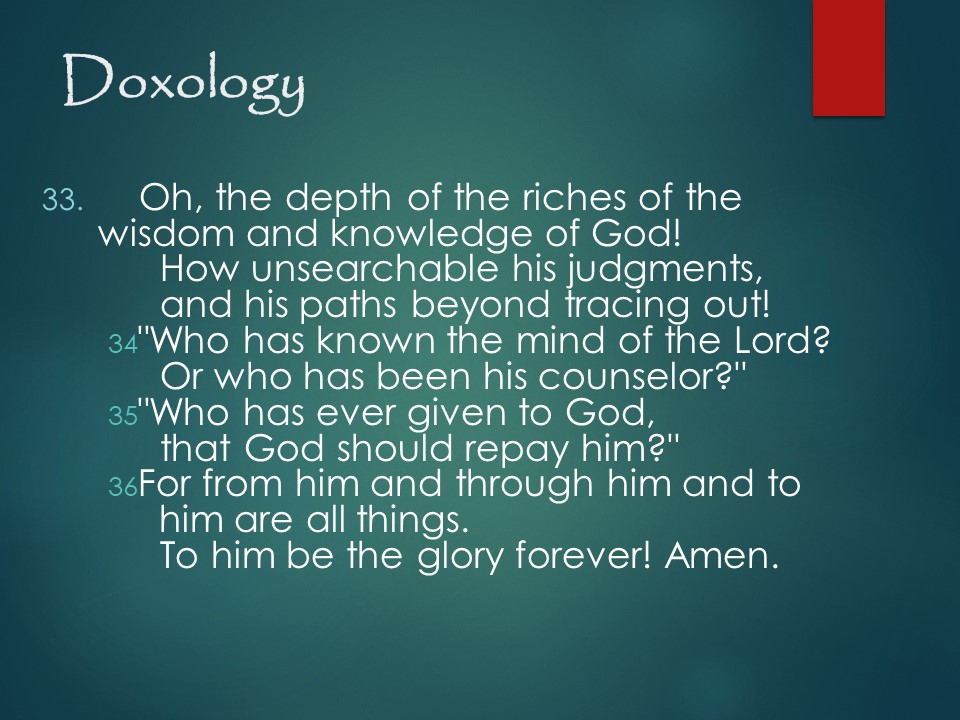
It seems that the world changes every week. What is a Christian, saved by the blood of Christ to do about it? We are not to worry, but how? The word for today is from Romans 11:
This hymn gives the answer how we are to live, the key is to abide.
Acts 19:1-22. Paul took the land route to Ephesus, where he met believers that had not even heard of the Holy Spirit. For two years Paul did many miracles there and did defeat evil Spirits, all to glorify Christ.
2 Chronicles 18. The prophet Micaiah warned Ahab of Israel,but Ahab listened to false prophets instead. The result was that Ahab died in battle.
2 Chronicles 19. King Jehoshaphat returned to Jerusalem and instituted a number of reforms.
2 Chronicles 20. Because Jehoshaphat turned to God, Ammon, Moab and Mount Seir were defeated and there was peace until the end of Jehoshaphat’s reign, but he made an alliance with Israel to build trading ships, and they were destroyed.
Acts 18:9-28. Paul left Athens and went to Corinth where he stayed a year and a half, teaching many in the city, among them Priscilla and Acquila. The three of them went to Ephesus, where Paul left Priscilla and Acquila and went to Antioch. Priscilla and Acquila met Apollos, a learned man preaching the baptism of John. “When Aquila and Priscilla had heard, they took him unto them, and expounded unto him the way of God more perfectly. And when he was disposed to pass into Achaia, the brethren wrote, exhorting the disciples to receive him: who, when he was come, helped them much which had believed through grace: For he mightily convinced the Jews, and that publicly, shewing by the scriptures that Jesus was Christ.”
2 Chronicles 15. Asa threw out the idols and repaired the altar before the Temple. People from Israel joined, and thanks to following the LORD Judah had peace until the 35th year of Asa’s reign.
2 Chronicles 16. Asa’s made a treaty with Syria. That was a mistake. Hannai’s Message to Asa was that Asa had not relied on the LORD. Four years later Asa died.
2 Chronicles 17. Jehoshaphat reigned in Judah, they took the Book of the Law around the country and taught the people. The fear of the LORD fell on the surrounding countries, so Judah had peace for years.
Psalm 47, of the Sons of Korah. “Sing praises to God, sing praises“.
Ephesians 4:4 There is one body and one Spirit, just as you were called to one hope when you were called; 5 one Lord, one faith, one baptism; 6one God and Father of all, who is over all and through all and in all.
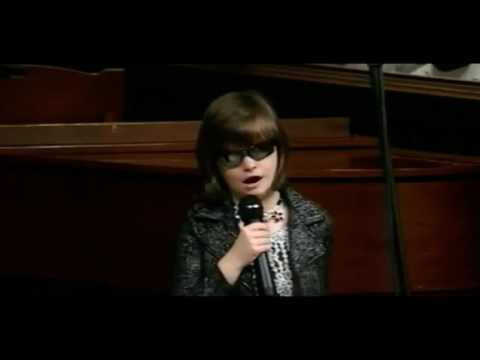
Twenty-two years ago a girl was born with undeveloped optical nerves and mild cerebral palsy. She was not expected to live more than at most one year. But God had other plans for her. At age two she began to sing. Her love for singing praises to God has never ceased. And so, in God’s providence she was chosen to sing at the 2017 presidential inauguration interfaith prayer service. And sing she did! Her name is Marlana VanHoose, a little girl, but with a voice.
Meanwhile, the media was busy tracking the protest rallies all around Washington that day. I watched all day and never saw this.
How did the audience that was privileged to watch react? It is worth to listen to it a second time, this time around watching the reaction of the public in attendance, notably Melania Trumps reaction.
After the song Melania led the standing ovation to acknowledge God’s grace, not only for the song, but for the whole day and for the whole presidency.
This is what give us evangelicals hope. The young woman not only sang it, she also sang the third and fourth verses, so often omitted in public settings, especially in interfaith services. Why is that important?
Let us look at the history of “O store Gud”, and how it came to be the most favored Hymn of at least three presidents before Donald Trump!
Clouds have always been my fascination. They come and go, form and disappear, cool by day and warm by night. But most impressive of all are thunderstorms, forming when the temperature and humidity are high, transport a lot of water vapor to higher elevations, there condensing as rain or ice, coming down, cooling and watering the earth. Clouds and thunderstorms are the thermostat of the earth. Without it the earth would respond like climate models, predicting a sharp temperature rise as carbon dioxide levels increase. The models are all flawed, since they predict a hot spot in the troposphere over the equator, but there is none. The thunderstorms in the tropical doldrums take care of that. “Settled science” instead has settled on ignoring the lack of the hot spot, for to acknowledge it would make the global warming claim invalid.
I thank God for providing us with a thermostat that protects the earth from overheating, and especially for thunderstorms!
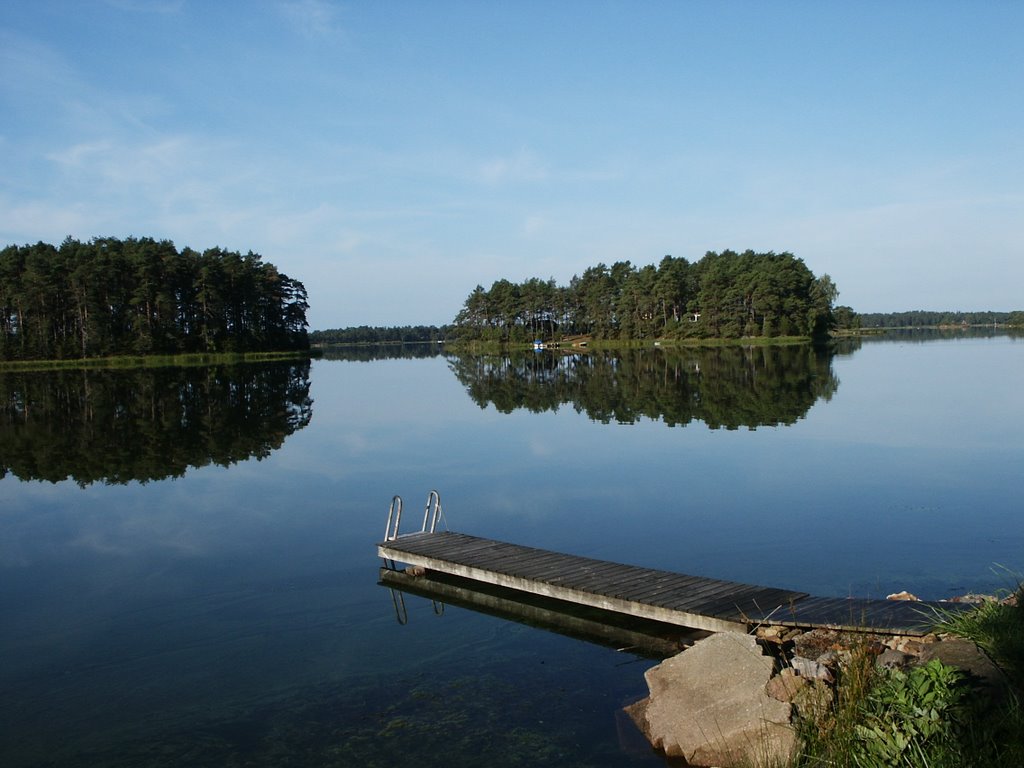
Such was the case in July 1885, when Carl Boberg, a 26 year young pastor of a small congregation of the Swedish Missionary society was the honored guest of the ladies’ auxiliary annual picnic, held in a meadow near Mönsteråsviken, (a bay of the Baltic Sea in southeastern Sweden). The day was perfect, the sky was clear, pleasant temperatures, the cows were grazing on the meadow, the birds were singing, in short, a pastoral idyll. Then it happened. In a few short minutes thunderclouds appeared out of nowhere. There was no time to go home, so they all sought shelter in a barn close by. The rain came down hard, and lightning struck a nearby tree. Then as suddenly as it started the rain stopped and all was calm. In Sweden it turns much cooler after a thunderstorm, and the birds sing like they got a new lease on life.
They all went home, and the young pastor pondered the events of the day. He
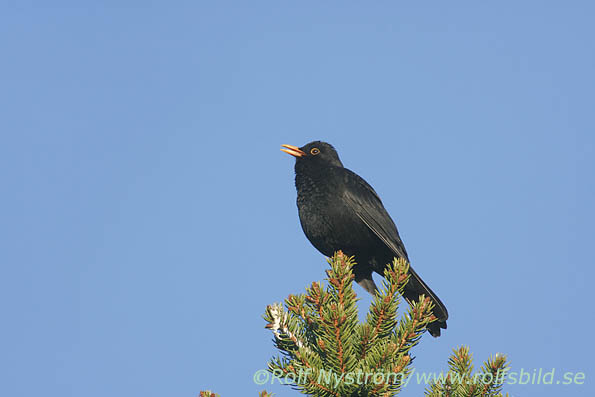
080419-11, digital 28,8 mb RAW, 12-00 Koltrast, Turdus merula Uppland
heard the Coalthrush singing its melodic, beautiful drill, and in a distance he heard the church bells ringing from Kronobäck’s church. The bay was calm like a mirror, and inspired he started penning the song “O store Gud”. Here is the first verse:
O Lord my God, When I in awesome wonder, Consider all the works Thy Hands have made; I see the stars, I hear the mighty thunder, Thy power throughout the universe displayed.
Refrain: Then sings my soul, My Savior God, to Thee, How great Thou art, How great Thou art. Then sings my soul, My Savior God, to Thee, How great Thou art, How great Thou art!
He continued to write and wrote of all the mighty works that God has made and what He has given us through His word, and continued long into the night. Before going to bed he had penned over twenty verses. The next Sunday he wove the poem into his sermon. They all loved it, but that was about it. Slowly the word got around the poem was pretty good, after much editing down, 9 verses were published in the local newspaper Mönsteråstidningen in 1886. Carl Boberg didn’t make any efforts to publish it further, and was surprised when he heard it sung a few years later to a Swedish folk melody (in 3/4 tempo). This was then published in the periodical “Sanningsvittnet” (witness of the truth) in 1891.
It was translated into German by an Estonian, Manfred von Glehn. Five years later it was translated into Russian by Ivan S. Prokanoff, the Martin Luther of modern Russia. It was published in a book with the title “Cymbals”.
Later, while in the Carpathian Mountains of what is now Western Ukraine the English Missionary couple Hine heard the song sung in Russian, this time as a wandering song in march tempo. He got impressed by God’s great works in the Polish mountains, and as Stuart Hine heard the people singing it on their way to church he penned a translation. This become the second verse:
When through the woods, and forest glades I wander, And hear the birds sing sweetly in the trees. When I look down, from lofty mountain grandeur And see the brook, and feel the gentle breeze.
Refrain
From now on the English version is different than the Swedish original. This is the origin of the third verse: It was typical of the Hines to ask if there were any Christians in the villages they visited. In one case, they found out that the only Christians that their host knew about were a man named Dmitri and his wife Lyudmila. Dmitri’s wife knew how to read — evidently a fairly rare thing at that time and in that place. She taught herself how to read because a Russian soldier had left a Bible behind several years earlier, and she started slowly learning by reading that Bible. When the Hines arrived in the village and approached Dmitri’s house, they heard a strange and wonderful sound: Dmitri’s wife was reading from the gospel of John about the crucifixion of Christ to a houseful of guests, and those visitors were in the very act of repenting. In Ukraine, this act of repenting is done very much out loud. So the Hines heard people calling out to God, saying how unbelievable it was that Christ would die for their own sins, and praising Him for His love and mercy. They just couldn’t barge in and disrupt this obvious work of the Holy Spirit, so they stayed outside and listened. Stuart wrote down the phrases he heard the Repenters use, and (even though this was all in Russian), it became the third verse that we know today: And when I think, that God, His Son not sparing; Sent Him to die, I scarce can take it in; That on the Cross, my burden gladly bearing, He bled and died to take away my sin.
Refrain
The second world war broke out, and the Hines’ were forced to return back to England, but they continued their ministry. The fourth verse was was added by Stuart Hine after the Second World War. His concern for the exiled Polish community in Britain, who were anxious to return home, provided part of the inspiration for Hine’s final verse. Hine and David Griffiths visited a camp in Sussex, England, in 1948 where displaced Russians were being held, but where only two were professing Christians. The testimony of one of these refugees and his anticipation of the second coming of Christ inspired Hine to write the fourth stanza of his English version of the hymn. According to Ireland: One man to whom they were ministering told them an amazing story: he had been separated from his wife at the very end of the war, and had not seen her since. At the time they were separated, his wife was a Christian, but he was not, but he had since been converted. His deep desire was to find his wife so they could at last share their faith together. But he told Hines that he did not think he would ever see his wife on earth again. Instead he was longing for the day when they would meet in heaven, and could share in the Life Eternal there. These words again inspired Hine, and they became the basis for his fourth and final verse to ‘How Great Thou Art’:
When Christ shall come, with shout of acclamation, And take me home, what joy shall fill my heart. Then I shall bow, in humble adoration, And then proclaim: “My God, how great Thou art!”
Refrain
The complete song was soon published, not in England but in the Soviet Union (in English). The famous Gospel singer George Beverly Shea got hold of it, liked it a lot, but he wanted to change two words in the first verse: Instead of works, he wanted to use worlds, and instead of mighty he wanted to use rolling. Very reluctantly Stuart Hine agreed, but only for use in the Billy Graham Crusades. It was first sung in Canada in 1955. It became so popular that in Billy Graham’s 1956 New York Crusade it was sung at all 99 events, and from there the song spread out through all the world, even back to Sweden where the new version became the popular one. One of the visitors to this Crusade was the boy Donald Trump, who went with his Father and Mother and Brother (and Sisters?) to listen. God’s word never returns void.
Acts 18:1-8. Paul left Athens and went to Corinth where he stayed a year and a half, teaching many in the city, and some believed. When the Jews opposed him Paul decided that he from then on would go to the Gentiles.
2 Chronicles 11. The LORD warned against going to war with Israel, so instead Rehoboam fortified the cities, the priests and Levites left Israel and moved to Judah. The family tree of Rehoboam is recorded.
2 Chronicles 12. Egypt Attacked Jerusalem and Judah paid the ransom. The reign of Rehoboam ended.






 Len Bilén's blog, a blog about faith, politics and the environment.