
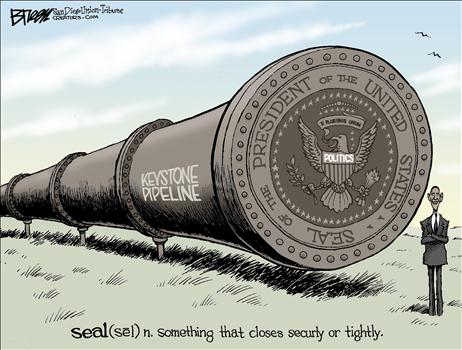
 The Obama administration announced Nov. 10 it would delay a politically explosive decision on the proposed Keystone XL oil sands pipeline until after the 2012 elections.
Congress corrected this dithering by forcing Obama to make a decision one way or another. He chose not to build it.
This decision was bad on so many levels it is hard to count them all.
Let’s try to look at the ways: Canada has oil sands and is exploiting the resources.
U.S. is dependent on importing a large portion of its crude oil.
The cheapest and most efficient way to transport crude oil is through a pipe line. It is also the safest and most reliable way of getting crude oil from point A to point B. To not O.K. the pipeline increases the cost and makes us more dependent of crude oil from the Middle East and Nigeria, as well as Venezuela. The cost of shipping this oil via pipeline is $5/barrel. To ship it via rail is about $15/barrel. This is the way it is done right now.
Canada really, really wanted this deal. It would help improve our relations. Now they are strained.
The unions really wanted the jobs. It would supply them with more than 20000 direct, well-paid jobs. In addition there is secondary business generated whenever a project of this magnitude is undertaken. Why not generate jobs?
The newly discovered oil fields in North Dakota and Montana could use the pipeline as well. Now they will have to go it alone or transport their oil on railroad or barge traffic instead, a more expensive and less safe option.
So why did Obama delay the decision? It was because of the environmentalists.
Let us examine why this decision was equally horrible from an environmentalist’s perspective.
Canada is a sovereign nation. They have the oil and will sell or use it one way or another.
The most energy conserving way is to transport it through a pipeline. Transport via train, truck or barge uses more energy (read more CO2), Canada will sell it’s oil to China if we don’t want it. China has a well deserved reputation for producing a lot of pollution.
The best environmental solution is for us to import this oil.
Nebraska protested there was a danger to damage their aquifer. The Keystone XL management offered to reroute the pipeline away from this sensitive aquifer, thereby solving that objection.
By not importing oil from Canada the total carbon footprint will increase. We lose, and Canada loses. (I am not concerned that the CO2 is increasing, but that a valuable natural resource is excessively depleted.) Now it turns out that Canada has left the Kyoto Protocol, thereby being free to burn as much of its carbon as they want. Was that really what the environmentalists wanted?
So why did Obama first delay the decision until after the 2012 election, and then, when forced, deny the permit? Here are five possibilities:
1. Obama is a true believer that ”this was the moment when the rise of the oceans began to slow and our planet began to heal”. As a true environmentalist his role can not be overestimated .
2. Obama is deliberately wrecking our economy, refuses to have an energy policy that will create jobs, but will support protest movements and foment unrest.
3. Obama is acting on orders from Global Governance people that do want U.S. to be totally dependent on international law and U.N. mandates.
4. Obama promised to be Brazil’s best customer from their deep sea oil drilling success, paid for by U.S. loan guarantees. He must be true to his promises.
5. Obama is half insane and surrounded by bad advisors.
This is the best I can do to explain the reasons for this decision.

 Len Bilén's blog, a blog about faith, politics and the environment.