Why Thorium? 19. Liquid Fluoride Thorium Reactors will lessen the need for an expanded national grid.

Liquid Fluoride Thorium Reactors will lessen the need for an expanded national grid. The National Electric grid is at the breaking point. It needs to be expanded, but neighborhood resistance is great in many areas where they need an expanded grid the most. The grid is also sensitive to terrorism activities.
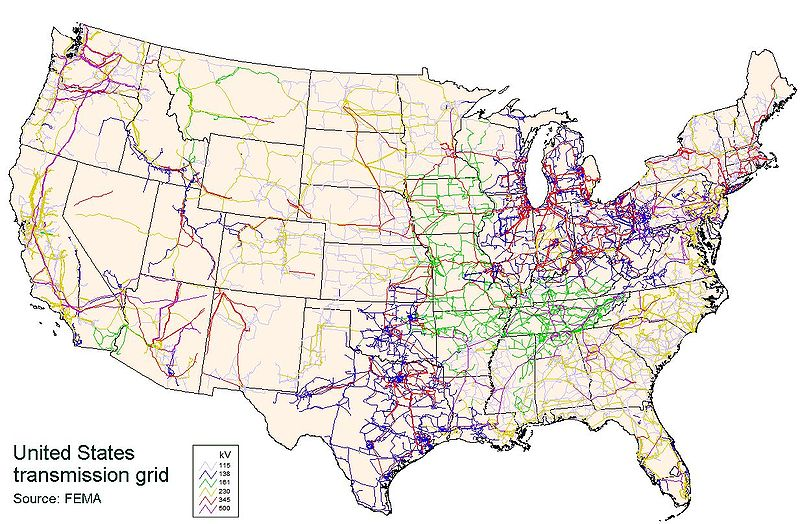
As we can see the national grid is extensive. It is also under severe strain at peak demand. Wind power will only increase the strain since most wind power is generated where few people live and work. A way to lessen the dependency on the national grid is to sprinkle it with many small to medium sized Thorium Nuclear Power generators. They can be placed on barges in rivers and along the coast where the need is greatest, giving the grid maximum flexibility to respond in  case of an emergency. LFTR’s do not depend on water for their cooling, so they can be placed anywhere, even in extreme arid areas. Since LFTR can be placed very close to urban centers, transmission losses are kept low. (The Texas grid is separately controlled from the rest of the grid.)

With the present push to convert energy sources to green energy, Thorium Nuclear energy is greener than both solar and wind energy if one includes the necessary mining to extract the materials needed for both solar and wind power. In addition thw wind blows where few people live or want to live, and the electric need is largest in the winter in the north when the sun is largely absent and the snow covers the solar panels, and the need in the south is largest in the summer when the wind blows less except for storms and hurricanes. This requires long transmission lines, and the grid is divided up in sections. The only way to solve this is to expand the grid through a HVDC (High Voltage Direct Current Network. This will be done through 1 MV cables, preferably using existing railroad rightaways when possible. One proposal is shown below. This would connect the Eastern, Western and the Texas network and significantly lessen transmission losses. (Transmission losses in the U.S. electrical grid is more than 50 Billion dollars yearly)

Transmission losses in a HVDC network are far less. Better yet is to place the energy source near the energy consumer. LFTR Thorium power would solve this problem. As we switch from gasoline powered to electric cars, the need to expand the grid will be more and more urgent, and the resistance to build more transmission lines is already great and growing, especially in already overloaded urban areas.

Why Thorium? 18. Liquid Fluoride Thorium Reactors will work both as Base Load and Load Following power plants.

Liquid Fluoride Thorium Reactors will work both as Base Load and Load Following power plants. LFTR’s operate at a much higher temperature than conventional power plants and operate at up to 45% electricity conversion efficiency, as opposed to 38% or lower for steam generators. In addition, because of the higher operating temperature it is ideal for hydrogen generation. The reactor would use the electricity generation to satisfy the current demand and produce hydrogen during times of low demand. This hydrogen would be temporarily stored and used for electricity production at peak demand. And  hydrogen fuel cells produce only water whenoxidized, no CO2  or polluting fumes are generated. With the objective of reducing the cost of hydrogen production,  solid oxide electrolyser cells (SOECs) are especially well suited.  SOECs operate at high temperatures, typically around 800 °C. At these high temperatures a significant amount of the energy required can be provided as thermal energy (heat), and as such is termed High temperature electrolysis.

Many years ago, I worked in a bakery as a helper, and we had a stone oven, heated at night when the electricity rates were a fraction of day rates, and in the morning when the oven was hottest we baked danishes, followed by buns, ended up with bread and cookies as the day wore on. Stone ovens make really good bread. Stone storage can store a lot of heat. They are used as heat storage in solar concentrators, up to 100 GWh. there may be a great future for heat storage with Thorium Nuclear plants. When demand is low it is kept at full temperature, up to 550 C and the gas, normally run through a generator is heating the storage tank or building, ready to be providing heat for the generators at high demand. This would help to limit the need for large batteries to stabilize electric output and provide fast response to varying load demands.

Why Thorium? 17. No need for evacuation zones, Liquid Fuel Thorium Reactors can be placed near urban areas.

No need for evacuation zones, can be placed near urban areas. Molten Salt Thorium reactors operate at atmospheric pressure and have a very high negative temperature coefficient, so there is no risk for a boil-over. They are easily made earthquake-safe and no pressure vessel is needed. This will greatly simplify the approval process, no need for elaborate evacuation plans have to be developed. Since the Three Mile Island accident there was a thirty year gap in approvals for new nuclear plants. The “not in my backyard ” mentality reigned supreme, and delay and denial was the rule of the years. But the lawyers still got their share, leading to escalating cost for new nuclear power. In the early days of nuclear power France took the approach of building some of their nuclear plants near the Belgian and German border, so they only had to develop half of an  evacuation plan, leaving the other half to their ‘understanding’ neighbors. It also lead to placing the nuclear plants where there was least popular resistance, not where they were needed the most, adding to the strain and efficiency losses on the electric grid. Liquid Fluoride Thorium Reactors have one additional advantage. They do not need access to water, so they can be placed even in desert areas. When a coal fired, or even a natural gas fired plant is decommissioned, it can be replaced in the same place, the electric connections are already there, so there is no need to go through lengthy and costly eminent domain processes ‘to acquire more land, or even expand the electric grid for that location. Thorium power is clean power.

Why Thorium? 16. Liquid Fluoride Thorium Nuclear reactors scale beautifully from small portable generators to full size power plants.

Thorium Nuclear Power generators  scale  beautifully from small portable generators to full size power plants. One of the first applications was as an airborne nuclear reactor.

Granted this was not a Thorium breeder reactor, but it proves nuclear reactors can be made lightweight. Thorium reactors can be made even lighter as long as they are not of the breeder type.

Lawrence Livermore, Los Alamos, and Argonne national laboratories are designing a self-contained nuclear reactor with tamper-resistant features. Called SSTAR (small, sealed, transportable, autonomous reactor), this next-generation reactor will produce 10 to 100 megawatts electric and can be safely transported on ship or by a heavy-haul transport truck.

This type of reactor can be transported to disaster areas, and provide emergency power, during rescue and rebuilding efforts. This particular reactor still uses solid fuel and steam heat exchanger. A LFTR reactor with a supercritical CO2 gas heat exchanger would be even more compact and efficient.

From these compact designs, Thorium power can be scaled up to any size. The LFTR reactor will be placed on barges and left moored in navigable rivers or in ocean harbors. This will typically be a one or two 250 MW LFTR with reprocessing capabilities. Where there is only road access the LFTR’s will be one or up to six 100 MW LFTR with one reprocessing fuel capability servicing the nuclear units one at a time on a rotary basis. These will come as complete units tested and ready for use on a number of trucks. It is to be noted that no water is necessary for cooling. There can also be 5 and 10 MW power units for freight trains and large towboats. They will not have reprocessing capabilities on board, but will be serviced regularily by refueling and reprocessing stations in key locations. Oceangoing ships will be fitted with LFTR reactors with reprocessing capability. When all of this is done the need for diesel fuel for nearly all shipping by train, barge or ship will be nearly eliminated.

Admittedly there are security risks associated with this arrangement. Locomotives and barges can be stolen, ships can be hijacked, when the whole reactor vessel came on a truck it can be stolen. By having minimum fuel at all time, it increases safety, but it also makes it possible for terrorists and common thieves to steal shipments of fuel and fissile by-products. This means that there must still be strict security measurements for maintaining chain of security for U-233 and Protactinium.

Why Thorium? 15. Virtually no spent fuel problem, very little on site storage or transport. U-232 is the preferred radioactive tracer.

 Virtually no spent fuel problem, very little on site storage or transport. I have been following the events at Fukushima Nuclear Power plants disaster with great interest. How ironic that one of the greatest problems was with the spent fuel, not with the inability to shut down the working units. The spent fuel issue is the real Achilles’ heel of the Nuclear Power Industry. The cost of reprocessing and storing spent reactor fuel will burden us for centuries after the reactors themselves have been decommissioned when their useful life is ended. Molten Salt Thorium nuclear power works differently from  conventional Uranium fueled Reactors as  the fissile fuel gets generated in the breeding process itself and nearly all fuel gets consumed as it is generated. When the process shuts down, that is it. Only the radioactivity that is en route so to say will have to be accounted for, not everything generated thus far in the process. The difference is about ten thousand to one in the size of the problem. It is high time to rebuild and expand our Nuclear power generation by switching to Thorium..

The detractors of Thorium like to point out that the Thorium-U233 process generates some U 232 in the presence of free neutrons. U-232 decays with a 69-year half-life through 1.9-year half-life Th-228 to Tl-208, which emits a 2.6 MeV gamma ray upon decay. Gamma rays are easily shielded by clean water, so transportation and storage is not a problem. Rather than being a problem, this is a great asset. The 232U decay chain is the source of the high energy gamma rays that make 232U the preferred tracer isotope. Uranium-232 has a half-life of 69.8 years, and the decay chain terminates at 208Pb (National Nuclear Data Center).

Why Thorium? 14. Molten Salt Nuclear Reactors have a very high negative temperature coefficient leading to a safe and stable control.

Molten Salt Nuclear Reactors have a very high negative temperature coefficient leading to a safe and stable control. This is another beauty of the molten salt design. The temperature coefficient is highly negative, making possible a simple and safe design enabling simple and consistent feedback. What does that mean?  It means that when the temperature of the fissile core rises, the efficiency of the reaction goes down, leading to less heat generated. There is no risk for a thermal runaway. This advantage is also true for Molten Salt Enriched Uranium Reactors. In contrast,  graphite moderated generators can have a positive temperature coefficient which leads to complicated control, necessitating many safety circuits to ensure controlled startup, operation and shutdown. Their worst failure mode is they can go prompt critical, and no containment vessel can contain the explosion that would occur, so they were built without one. There have been several major accidents in graphite moderated reactors, with the Windscale fire and the Chernobyl disaster being the largest and best known..

Why Thorium? 13. Molten Salt Liquid Fluoride Thorium Reactors cannot have a meltdown, the fuel is already molten, and it is a continuous process. No need for refueling shutdowns.

refueling shutdowns.

With Molten Salt nuclear Reactors there is no risk for a meltdown, the fuel is already molten, and that is a safe design. The fissile fuel in a Thorium reactor is U-233 in the form of UraniumFluoride (UF4) salt which also contains Lithium and Beryllium to lower the melting point, the operating temperature is held below 650C to allow reasonably priced and available alloys that also withstand high radiation. In its molten form the salt has a very low vapor pressure. The salt flows easily through the heat exchangers and the separators. The salt is very toxic, but since it is completely sealed it is not corrosive. Being a fluid, it is constantly mixed for optimum efficiency. The reactor will never have to be shut down for refueling, it is a continuous flow process. Uranium-235 Nuclear reactors on the other hand have to be shut down for refueling and rebalancing of the fuel rods a little more often than once every two years. The average shutdown is 35 days, or about 5% of the time. Then comes the major problem of safely and securely transporting and reprocessing the spent fuel. This problem is not yet solved for conventional Nuclear power plants, so spent fuel is stored on site, sometimes for years. In a LFTR the fuel is spent as it is produced, so the fissile inventory is constantly kept at a minimum, and fission products and extra generated U-233 is separated out. this is a much cleaner process than reprocessing spent fuel. The high operating temperature gives the LFTR a much more efficient carnot cycle conversion factor of more than 40%, whereas conventional nuclear plants with water as a coolant medium cannot exceed 38% efficiency.

Why Thorium? 12. Atmospheric pressure operating conditions, no risk for explosions. Much safer and simpler design.

Molten Salt nuclear Reactors operate under Atmospheric pressure  conditions, no risk for explosions. Materials subjected to high radiation tend to get brittle or soften up. Molten Salt Thorium nuclear reactors operate under atmospheric conditions so the choice of materials that can withstand both high temperatures and high radiation is much greater, leading to a superior and less expensive design.  There is no high pressure gas buildup and the separation stage can be greatly simplified, leading to a much safer design. (From Wikipedia:)

The LFTR needs a mechanism to remove the fission products from the fuel. Fission products left in the reactor absorb neutrons and thus reduce neutron economy. This is especially important in the thorium fuel cycle with few spare neutrons and a thermal neutron spectrum, where absorption is strong. The minimum requirement is to recover the valuable fissile material from used fuel.

Removal of fission products is similar to reprocessing of solid fuel elements; by chemical or physical means, the valuable fissile fuel is separated from the waste fission products. Ideally the fertile fuel (thorium or U-238) and other fuel components (e.g. carrier salt or fuel cladding in solid fuels) can also be reused for new fuel. However, for economic reasons they may also end up in the waste.

On site processing is planned to work continuously, cleaning a small fraction of the salt as often as practical and sending it back to the reactor. There is no need to make the fuel salt very clean; the purpose is to keep the concentration of fission products and other impurities (e.g. oxygen) low enough. The concentrations of some of the rare earth elements must be especially kept low, as they have a large absorption cross section. Some other elements with a small cross section like Cs or Zr may accumulate over years of operation before they are removed.

As the fuel of a LFTR is a molten salt mixture, it is attractive to use pyroprocessing, high temperature methods working directly with the hot molten salt. Pyroprocessing does not use radiation sensitive solvents and is not easily disturbed by decay heat. It can be used on highly radioactive fuel directly from the reactor. Having the chemical separation on site, close to the reactor avoids transport delays and risks and keeps the total inventory of the fuel cycle low. Ideally everything except new fuel (thorium) and waste (fission products) stays inside the plant.

One potential advantage of a liquid fuel is that it not only facilitates separating fission-products from the fuel, but also isolating individual fission products from one another, which is lucrative for isotopes that are scarce and in high-demand for various industrial (radiation sources for testing welds via radiography), agricultural (sterilizing produce via irradiation), and medical uses (Molybdenum-99 which decays into Technetium-99m, a valuable radiolabel dye for marking cancerous cells in medical scans).

Mo-99 is used in hospitals to produce the technetium-99m employed in around 80% of nuclear imaging procedures. Produced in research reactors, Mo-99 has a half-life of only 66 hours and cannot be stockpiled, and security of supply is a key concern. Most of the world’s supply currently comes from just four reactors in Belgium, the Netherlands, Russia and South Africa, and recent years have illustrated how unexpected shutdowns at any of those reactors can quickly lead to shortages. Furthermore, most Mo-99 is currently produced from HEU targets, which are seen as a potential nuclear proliferation risk.

With the Mo-99 having a half-life of 66 hours and being continuously separated out from the fertile core in a LFTR, this seems to be the ideal vehicle to cheaply produce ample supplies of this valuable medical resource.

While LFTR reactors can be built today safely and profitably, much work remains to be done to achieve the full eight to ten thousand times reduction in TRU waste and maximize the breeding rate of U-233 for optimal speed of expanding the Thorium program.

Why Thorium? 11. Liquid Fluoride Thorium Reactors are earthquake safe, only gravity needed for safe shutdown.

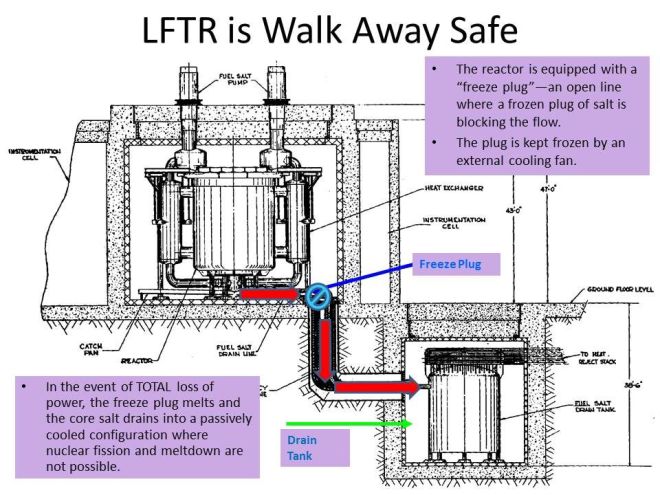
Molten Salt Thorium Reactors are earthquake safe. Thorium reactors have a very simple and compact design where gravity is the only thing needed to stop the nuclear reaction. Conventional nuclear reactors depend on external power to shut down after a SCRAM, where poison rods fall down to halt the reaction.  The next figure shows the concept of a Thorium reactor.

The idea is to empty the fissile U-233 core through gravity alone. All that is needed is a melt-plug that is constantly cooled by cold air. In an earthquake or complete electric failure the cold air flow automatically shuts off, and since the fuel is already molten, it will melt the plug, and the molten fluid will run down into channels like pig-iron into heat exchangers that absorb the residual heat.

As we can see the reactor hardened structure is compact, and can be completely earthquake and tsunami proof. What can be sheared off are the steam pipes and external power, but even then the reactor shutdown will  be complete safe without any additional power.

One of the advantages of the LFTR reactor is that the fissile compartment is always kept just above critical point for needed power delivery. This means, once it starts draining, the fission process ends immediately. The only nuclear reaction remaining is that the Protactinium generated in the fertile blanket and separator gets converted to U-233 over time, but the amounts are so small that it is always in the safe range.

Why Thorium? 10. Produces isotopes that helps identify, treat and cure certain cancers and other medical conditions.

For decades, medical researchers have sought treatments for cancer. Now, Alpha Particle Immunotherapy offers a promising treatment for many forms of cancer, and perhaps a cure. Unfortunately, the most promising alpha-emitting medical isotopes, actinium-225 and its daughter, bismuth-213, are not available in sufficient quantity to support current research, much less therapeutic use. In fact, there are only three sources in the world that largely “milk” these isotopes from less than 2 grams of thorium source material. Additional supplies were not forthcoming. Fortunately, scientists and engineers at Idaho National Laboratory identified 40-year-old reactor fuel stored at the lab as a substantial untapped resource and developed Medical Actinium for Therapeutic Treatment, or MATT, which consists of two innovative processes (MATT-CAR and MATT-BAR) to recover this valuable medical isotope. One byproduct generated is a valuable isotope for medical uses, Molybdenum-99 which decays into Technetium-99m, a valuable radiolabel dye for marking cancerous cells in medical scans.

In 2019 The US Department of Energy’s National Nuclear Security Administration (NNSA)  selected four companies to begin negotiations for potential new cooperative agreement awards for the supply of molybdenum-99 (Mo-99) without using highly enriched uranium (HEU).

Mo-99 is used in hospitals to produce the technetium-99m employed in around 80% of nuclear imaging procedures. Produced in research reactors, Mo-99 has a half-life of only 66 hours and cannot be stockpiled, and security of supply is a key concern. Most of the world’s supply currently comes from just four reactors in Belgium, the Netherlands, Russia and South Africa, and recent years have illustrated how unexpected shutdowns at any of those reactors can quickly lead to shortages. Furthermore, most Mo-99 is currently produced from HEU (Highly enriched Uranium) targets, which are seen as a potential nuclear proliferation risk.