Romans 8:28-39. This is my favorite chapter in all the Bible, and is far too important for my feeble comments. Read it together with all the Old Testament references, let them serve as the commentary; then read it again. Let it sink in, then pray with thanksgiving.
Proverbs 11. The list of Solomon’s Proverbs is many chapters long.
Psalm 62, of David. David, as always claimed God to be his rock and salvation, even when surrounded by false and evil men, he would not be moved. All power belongs to God.
Romans 8:1-27. This is my favorite chapter in all the Bible, and is far too important for my feeble comments. Read it together with all the Old Testament references, let them serve as the commentary; then read it again. Let it sink in, then pray with thanksgiving.
Esther 8. With Haman out of the way, the Jews were still in peril, since the edict of the king could not be changed, so Esther pleaded again to the king and a new edict was proclaimed, the the Jews had every right to defend themselves and strike back, and so Esther saved the Jews.
Esther9. The Jews triumphed, and the first Purim was celebrated.
Esther 10. Epilogue about the greatness of Mordecai.
To begin cost estimates, the model used is the cost for the Arizona central project. The waterway was constructed 1974 to 1993 at a cost of 4.7 billion dollars. In 2021 dollars that would be about 12.8 billion. The cost for the canal would be about 12 billion and 800 million for the pumping stations. The average size of the aqueduct in its beginning is 80 feet across the top and 24 feet across the bottom and the water is 16.5 feet deep. The concrete is 3.5 inches thick and, in some areas, it is reinforced with steel rebars. It is 336 miles long from Lake Havasu City to Tucson with a total lift of over 2,900 feet. The capacity starts out at over 2.2 million acte-ft per year, diminishing as the drop-off point occurs, and the total pumping of 1.4 million acre feet of water is lifted by up to 2,900 feet by 14 pumping stations using 2,500 GWh of electricity each year. The pumping stations have a total pumping capacity of 240 MW.
The transcontinental aqueduct is much bigger: The The average size of the aqueduct in its beginning is 220 feet across the top and 65 feet across the bottom and the water is 44 feet deep. The concrete is 4.5 inches thick and, in some areas, it is reinforced with steel rebars. The concrete used is 16,500 cu yd per mile. It will cost about five times as much per mile as the ACP, so the total cost for the Transcontinental Aqueduct will be (12x 5 : 336 x 1505) = 268 billion dollars.
The cost of building the dams are estimated at $1 billion per dam. There are 15 dams, of which 11 must be built before aqueduct is operational at half capacity.
There is a total of 29.1 GW of pumped power and 3.8 GW of base power generated. To get the aqueduct operational at 7.5 MAF/year it requires 16.5 GW of energy. Pumping cost capital is about $ 1.30 per watt, so the minimum pumping capital cost is 21.5 Billion dollars. When the aqueduct is fully built up the capital cost for pumping includes 23.3 GW of peak power, raising the cost to $ 52 Billion’
The Liquid Fluoride Thorium Reactor chosen is a 100 MW unit. The reactor core assembly is small enough so it can be produced on an assembly line and delivered on truck. It can be built for $ 230 million. To complete the installation costs another # 30 million per unit. The aqueduct needs 146 for minimum flow, and another 145 when it is fully built out. The initial capital cost for grid access and minimum flow is $38 billion, double that when fully built out.
To sum it up,the capital cost for a flow of 7.5 MAF is (268 +21.5 + 38) = 327.5 billion dollars. At a flow of 15.5 MAF the cost is 387 billion. To add another 22.1 GW of 5 hour peak power per day add 5 billions for 4 dams and tunnels and 28 billion for pumps = 33 billion dollars
Romans 7. Thanks to the death and resurrection of Jesus Christ, we are free from the Law when we belong to Him. Yet, we struggle with sin; “For that which I do I allow not: for what I would, that do I not; but what I hate, that do I.” The chapter ends up with “O wretched man that I am! who shall deliver me from the body of this death? I thank God through Jesus Christ our Lord. So then with the mind I myself serve the law of God; but with the flesh the law of sin.” It will all make sense in chapter 8.
Esther 5. Esther prepared for a banquet with only her, the King and Haman in attendance. Meanwhile Haman’s rage against Mordecai was so great that he had built a seventy-five feet high gallows, on which to hang Mordecai.
Esther 6. As it so happened, the king had a case of insomnia. To become drowsy he had the annals read to him, which told that Mordecai had averted a coup. During the banquet the king wanted to honor somebody, and rather than Haman, Mordecai was honored.
Esther7. And so it was, Haman was hanged on the gallows he had built for Mordecai.
Psalm 61, of David. As so often happened, David was in trouble and cried out to God, proclaiming his trust in God, singing praises.
Romans 6. The three most important truths are: “Reckon ye also yourselves to be dead indeed unto sin, but alive unto God through Jesus Christ our Lord.” “But now being made free from sin, and become servants to God, ye have your fruit unto holiness, and the end everlasting life.“ and “For the wages of sin is death; but the gift of God is eternal life through Jesus Christ our Lord.” It is a fantastic chapter, read it and meditate.
Esther 2. The search for a new queen was on and Esther became the new queen. Mordecai, Esther’s cousin, uncovered a conspiracy against the king.
Esther3. Enter Haman, an Agagite. (There was great animosity between the Agagites and the Jews since the time of king Saul.) He was great in the kingdom, and everybody bowed down to him – except Mordecai. This enraged Haman, so he offered 750 tons of silver to the king’s treasury for being allowed to kill all Jews. Fair enough, deal signed and sealed, (and the king’s seal cannot be undone.)
Esther 4. Mordecai persuaded Esther to risk her life to save the Jews, and Esther’s response was “If I perish, I perish”.
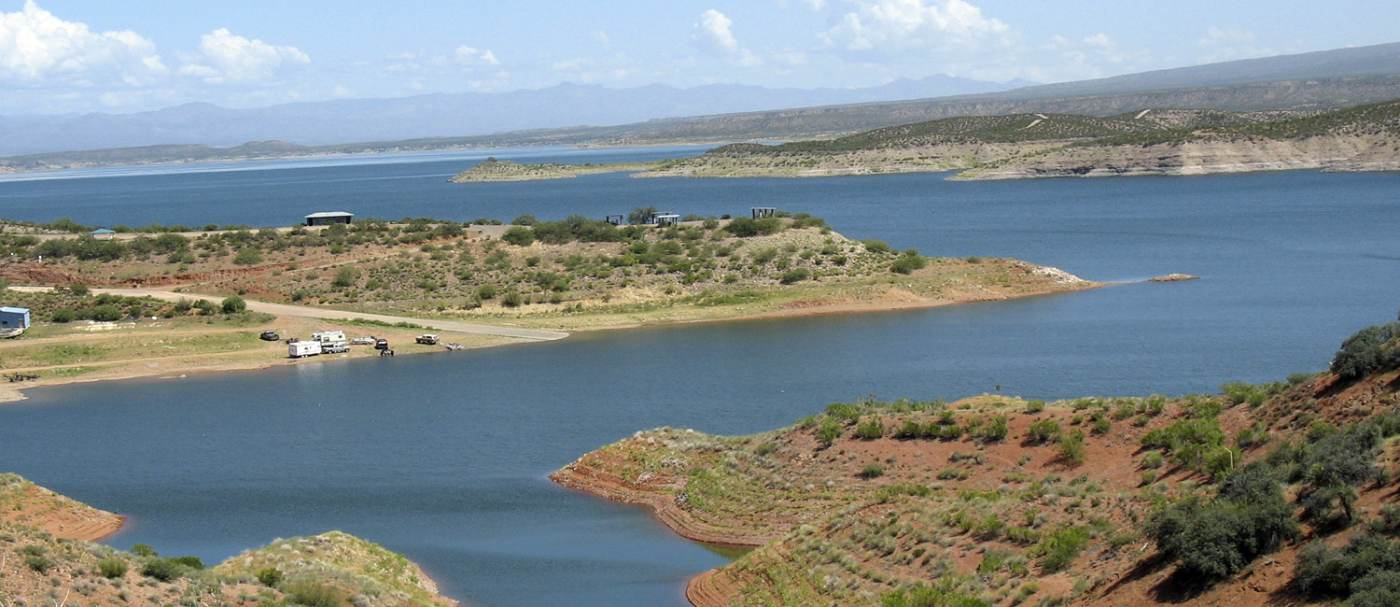
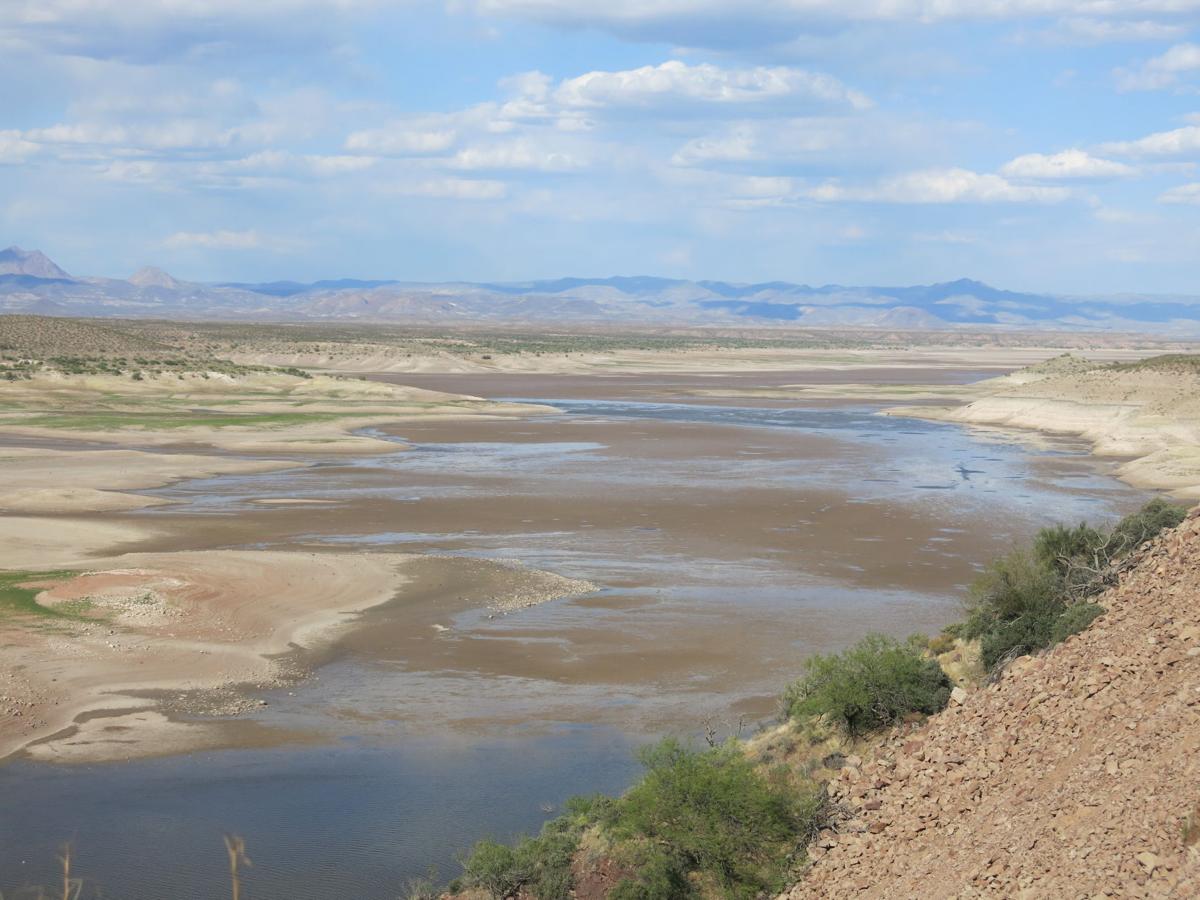
Stage 12 is a true delivery of water on demand aqueduct. The San Carlos lake has a storage capacity of a million acre-ft, the ideal buffer from the peak power demand driven uphill stages to the major delivery stage. San Carlos lake is now mostly empty, but will be normally filled to 85% of capacity, slightly less in advance of the winter snow melt. The Lake would look like this:
San Carlos lake, about half full
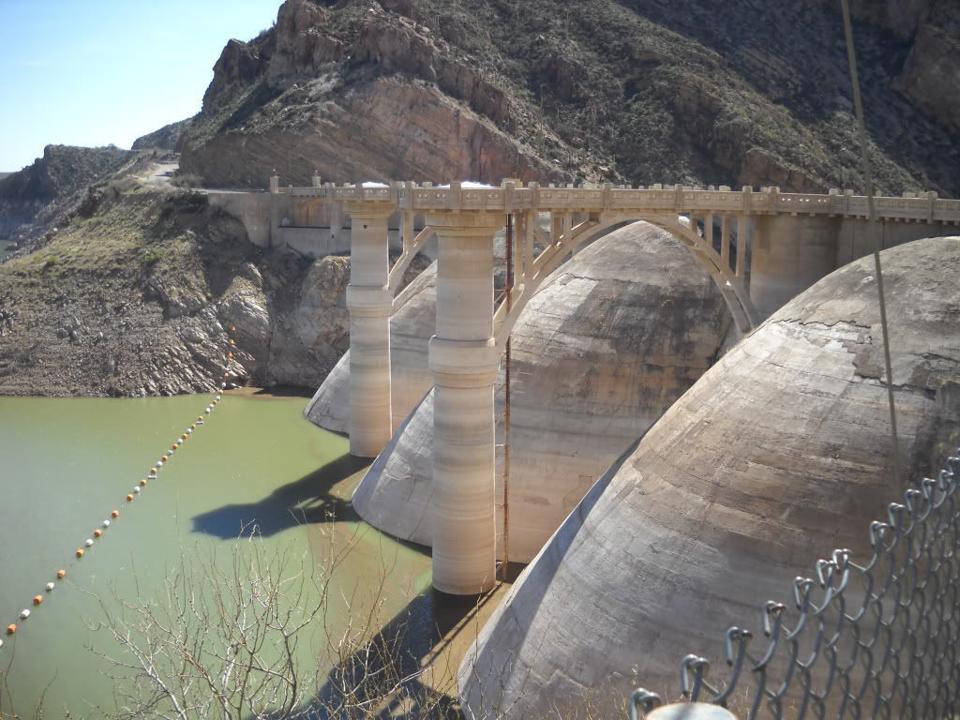
The Coolidge dam is now decommissioned, the lake is too often empty and the dam suffered damage in the power plant and it was no longer economical to produce power. The retrofitted dam will have a power generation capacity of up to 19,000 cfs the top of the dam is at 2535 ft, the typical water level is at 2500 ft and the drop is 215 feet, giving a maximum power output of 325 MW.
Coolidge dam before rebuilding
From there the stream follows the Gila River all the way to the Colorado River with the following dropoffs:
Where the Arizona central project waterway crosses the Gila river it will deliver up to 500 cfs to Tucson
Where the Gila river meets the Salt river it can deliver up to 1,500 cfs to the Phoenix-Scottsdale metropolitan area.
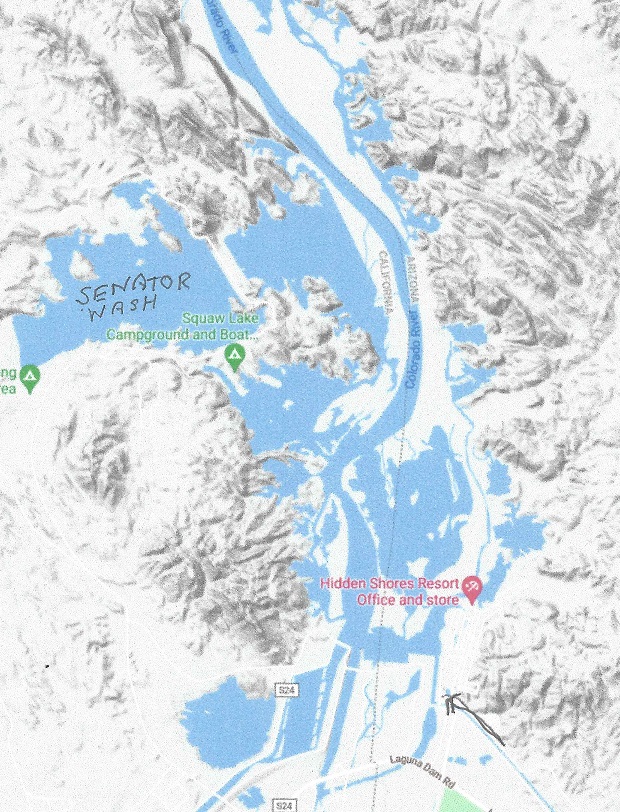
To the Martinez lake it can deliver up to 15,155 cfs, the design capacity of the All American canal. This will of course be nearly always far less, dependent on the need for water for irrigation, but we dimension the aqueduct to accomodate maximum flow. The Martinez lake is puny, and would easily be overwhelmed by surges in the water flow. To accommodate this, the Senator Wash Reservoir will have to be upgraded to be able to pump up or down at least twice as much water as is it present capacity. Lake Martinez is at about 180 feet elevation, and Senator Wash Reservoir is at a maximum elevation of 240 feet.
The Martinez lake and the Senator Wash Reservoir.
The rest of the Transcontinental Aqueduct empties out where the Gila river joins the remainder of the Colorado river a few miles downstream. It will be able to carry up to 6, 000 cfs of water to accommodate the needs of Mexico and also provide a modest amount of water to assure the Colorado river again reaches the ocean, maybe restoring some shrimp fishing in the ocean.
The 1944 water treaty with Mexico provides Mexico with 1.5 million acre-ft per year, more or less dependent of drought or surplus. It will be increased only on condition that when the Transcontinental aqueduct is finished, the New River in Mexicali will be cut off at the border, and Mexico will have to do their own complete waste water treatment.
There will be water allocated to the Salton Sea. Proposed will be the world’s largest Lithium mine, mining the deep brine, rich in Lithium. (about 40% of the world supply according to one estimate). This requires water, and as a minimum to allow mining in the Salton Sea the water needs to be cleaned. This requires further investigation, but the area around the Salton Sea is maybe the most unhealthy in the United States.
The maximum power generating drop during this last leg will be (2500 – 190 – 2.2X 280) = 1694 feet. With an average flow of 14,000 cfs this will generate 1.9 GW of power, but the realized power output will be determined by the actual water demands.
Romans 5:12-21. Death came through one man, Adam, but “if by one man’s offence death reigned by one; much more they which receive abundance of grace and of the gift of righteousness shall reign in life by one, Jesus Christ.” Let that sink in.
Esther 1. A fantastic book that made it to the Holy Bible, even though the name of God is not mentioned, not even once! Yet, the hand of God is everywhere in it. Read all of it! It starts with a big, decadent feast, and queen Vashti refused to make a spectacle of herself so she was deposed. Now what do you do without a queen?
Psalm 59, of David. A prayer for deliverance from Saul and his men seeking to Kill David. It ends up with David singing God’s praises.
Psalm 60, of David. A Psalm intended for teaching. Even though they were defeated, David gave God the glory for future victories and deliverance.
Romans 5:1-11. This is a great chapter and tells how faith triumphs in trouble, one quote: “God commendeth his love toward us, in that, while we were yet sinners, Christ died for us.”
Proverbs 10 contains some of the wise sayings of Solomon, with New Testament thoughts sprinkled in.
Psalm 56 , of David. The Psalm is from the time when the Philistines captured him in Gath It deals with the period between the visit to the tabernacle at Nob and David’s arrival at Adullam. David was alone, desperate, afraid – and had no one left to to trust but the LORD.
Psalm 57 , of David. Charles Spurgeon noted, “There are four of these ‘Destroy not’ psalms, namely, the 57th, 58th, 59th, and 75th. In all of them there is a distinct declaration of the destruction of the wicked and the preservation of the righteous.” It ends with “Be thou exalted, O God, above the heavens: let thy glory be above all the earth.“
Psalm 58, of David. A short, but intense prayer that God would punish the wicked and judge righteously.
Romans 4. Abraham was justified by faith, not works and definitely not circumcision. Where there is no law, there is no transgression. Against all hope, Abraham in hope believed, and it was credited to him as righteousness. And “for us also, to whom it shall be imputed, if we believe on him that raised up Jesus our Lord from the dead; Who was delivered for our offences, and was raised again for our justification.”
Nehemiah 12 lists the priests and Levites, the time had come for Nehemiah to dedicate the wall, and the temple responsibilities were specified.
Nehemiah 13. The final reforms of Nehemiah are recorded, the temple service is given its due, and a final admonition from Nehemiah: Observe the Sabbath and don’t marry strange women.
Stage 10 was a true pumped hydro-storage peak power stage, producing up to 11.5 GW electric power for up to 5 hours a day. In stage 11 the flow will be a maximum flow of up to 25,000 cfs, but with periods of less flow during low electricity demand, all to accommodate both water needs and power demands.
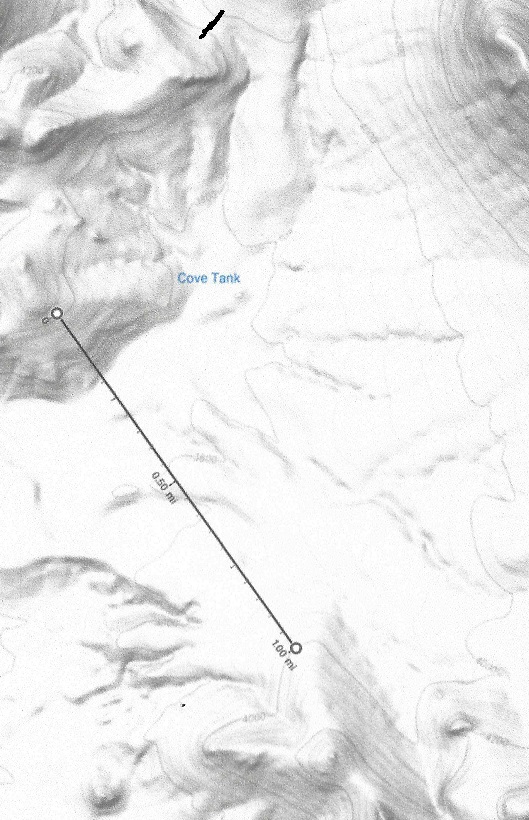
The Cove Tank Reservoir dam is 1 mile wide and 250 feet high, the top of the dam is at 4,000 feet. containing up to 60,000 acre-ft of water, enough storage for more than a day’s flow.
The Cove tank Reservoir starts out nearly empty when peak power demand starts, and is rapidly filling up until peak demand ends
The power generating drop is on average (3800 – 2535 – 70×2.2) = 1,111 feet. This stage is capable of generating maximum 2.2 GW of power during peak power demand, adjusted down at low power demand to not exceed the daily water supply.
San Carlos lake is located within the 3,000-square-mile (7,800 km2) San Carlos Apache Indian Reservation, and is thus subject to tribal regulations. It has been full only three times, in 1993 it overflowed the spillway and about 35,000 cfs of water caused erosion damage to natural gas pipelines. The lake contains now (April 6,2021) less than 100 acre-ft of water. All fish is dead.
When former President Coolidge dedicated the dam in 1930, the dam had not begun to fill. Humorist Will Rogers looked at the grass in the lake bed, and said, “If this were my dam, I’d mow it.”[
When the Transcontinental aqueduct is built the lake will always be nearly filled, with flood control nearly automatic, it will never overflow, and it will look like this:
The San Carlos lake, when filled will hold 1,000,000 acre-ft of water.
The Coolidge dam will have to be retrofitted for a 25,000 cfs water flow