When a critical mass of American people realize what has been done to them, there will need to be a reckoning.
By Debra Heine
March 4, 2022
In recent weeks, there have been several stunning revelations concerning the COVID-19 mRNA vaccines—and they are being all but ignored by a corporate media eager to change the subject.
The FDA on Tuesday released a large tranche of Pfizer clinical trials documents in response to a Freedom of Information (FOIA) request by the Public Health and Medical Professionals for Transparency. The documents show that the company knew people were at risk of experiencing more than 1,000 unique adverse side-effects to the mRNA injections.
Additionally, scientists last week revealed that Pfizer’s COVID-19 vaccine can enter human liver cells and be converted into DNA—something the fact-checkers and the U.S. Centers for Disease Control assured the public could never happen. Scientists also recently discovered that a sequence of genetic material patented by Moderna in 2018 bears a suspicious similarity to the spike protein in Sars-Cov2.
And a new study published on March 2 found that the synthetic mRNA found in the vaccines does not degrade quickly as promised, but continues to produce spike proteins for nearly two weeks.
Amid these new discoveries, the medical establishment won’t stop pushing the genetic vaccines that have failed to stop the coronavirus.
The COVID pandemic now plays second fiddle to the Russia-Ukraine war in the media, but the virus continues to rage through highly vaccinated countries, afflicting the triple-vaxxed most of all.
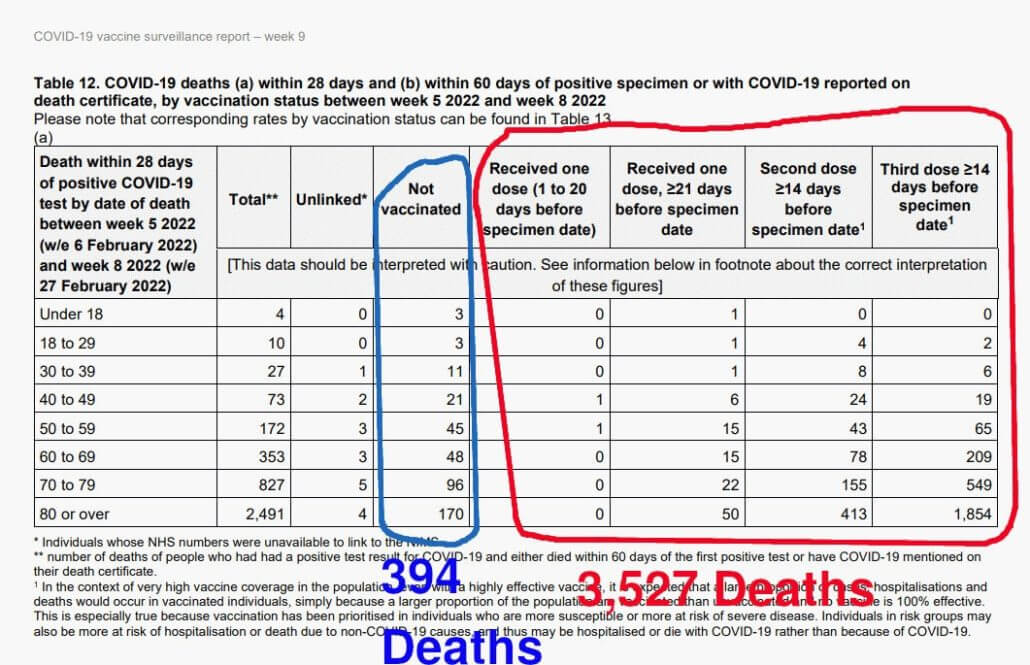
In the United Kingdom, only 394 vaccine-free persons died in weeks 5-8 of 2022, compared to the 3,527 who were vaccinated, according to the UK Health Security Agency. This means unvaccinated Brits only comprised 10 percent of all COVID deaths during those weeks.
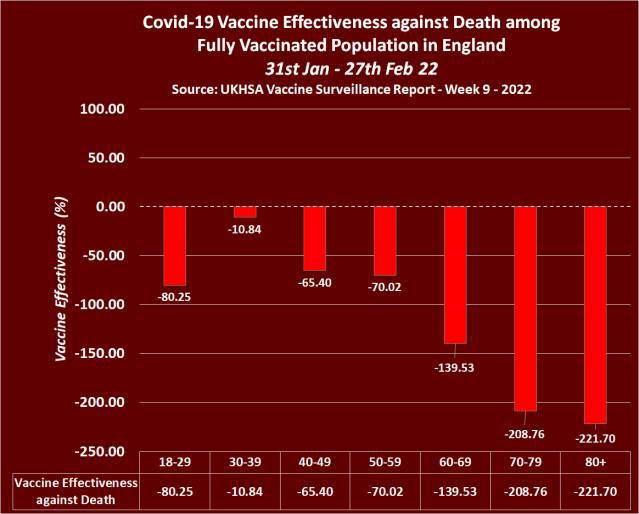
The effectiveness of the vaccine is shown in this chart
In other words, if you are over 70 years old your risk of dying from COVID is more than three times as large if you are vaccinated. It’s no wonder Pfizer wanted to hide the data for 75 years.
“This is a bombshell,” said Children’s Health Defense (CHD) president and general counsel Mary Holland. “At least now we know why the FDA and Pfizer wanted to keep this data under wraps for 75 years. These findings should put an immediate end to the Pfizer COVID vaccines. The potential for serious harm is very clear, and those injured by the vaccines are prohibited from suing Pfizer for damages.”
It contains more revealing data about the “safety” of the “vaccine”, well worth a second look. The article also shed some light on the Moderna patent that was issued three years prior to the outbreak of COVID-19. That was the reason a vaccine was ready to be tested one week after getting the warp speed go-ahead to develop a vaccine. The “Warp Speed” component was a promise to buy the vaccine in large quantities, whether it worked or not, thus eliminating the production ramp up. This also eliminated the economical and legal risk for the pharmaceutical companies. By not evaluating and acting on the results from the emergency use of the vaccine the Pharmaceutical companies are responsible for a large number of COVID deaths by vaccine. By reducing the immunity level of the vaccinated there are also an increase in the number of non vaccine related deaths; yet to be published.
Matthew 18:10-35. This chapter contains the parable of the lost sheep, which leads naturally into the subject of forgiveness, reconciliation and church discipline. Jesus also promised that “where two or three come together in my name, there am I with them”. The chapter ends with the parable of the unmerciful servant.
Numbers 33 is a reciting of Israel’s Journey from Egypt, and provides instructions on how the Israelites were to conquer Canaan.
Numbers 34, defines the Boundaries of Canaan and mentions all the leaders appointed to divide the land.
Numbers 35 defines the forty-two Cities for the Levites and their six Cities of Refuge.
Numbers 36 tells about the Inheritance of Zelophehad’s Daughters and why the Israelite women must marry within their tribe.
Matthew 18:1-10. To the question: “Who is the greatest in the kingdom of heaven?” Jesus called a little child. Then he expanded the question and elaborated on the subject of sin.
In Numbers 29 the specifications for offerings continue, Offerings at the Feast of Trumpets, Offerings at the Day of Atonement and finally Offerings at the Feast of Tabernacles.
Numbers 30 is short, and it deals with what the Law says about vows.
Numbers 31. The Israelites executed vengeance on the Midianites, returned from the war and dividied the spoils.
Numbers 32, The Reubenites, the Gadites and the half-tribe of Manasseh decided to settle East of Jordan.
Psalm 18 is the fourth longest psalm. David wrote it ” To the Chief Musician. A Psalm of David the servant of the LORD, who spoke to the LORD the words of this song on the day that the Lord delivered him from the hand of all of his enemies and from the hand of Saul. And he said:” (Read it, ponder and enjoy it.)
Matthew 17:14-27. The disciples tried to heal a boy with epilepsy but failed. Jesus healed him immediately. The disciples could not do it because they had so little faith. Jesus also predicted his death, and the tax collectors came to Peter to collect the poll tax. Jesus solved this by telling Peter to go fishing and from the first fish he caught he would take the four drachma coin swallowed by the fish. That did take care of the tax for both Peter and Jesus.
Numbers 26 lists in detail, by tribe, the Second Census of Israel.
Numbers 27 defines inheritance laws, and it was decided that Joshua should succeed Moses.
Numbers 28 is all about offerings, the Daily Offerings, Sabbath Offerings, Monthly Offerings, Offerings at Passover and Offerings at the Feast of Weeks.
Psalm 17 demonstrates David’s total trust in God and not in self in spite of David’s best efforts. It can be summarized: “Keep me as the apple of Your eye; Hide me under the shadow of Your wings” with regard to the threats from David’s enemies.
Matthew 16:13-28. Peter made his famous confession: “Thou art the Christ, the Son of the living God.” Right after that Jesus predicted his death, unto which Peter said “Never” and Jesus answered “Get behind me, Satan.” Those were strong words. Jesus furthermore said “Whosoever will lose his life for my sake shall find it.” Finally Jesus predicted his transfiguration.
In Numbers 21 the Canaanites were defeated in Hormath. The people kept speaking against God, so God sent venomous snakes their way and many died. Moses made a bronze snake, put it on a pole and when people looked at it, they got healed. (Does that remind you of a symbol used even today?) The travels continued.
Numbers 22 tells the story of how Balak sent for Balaam, and how Balaam’s Donkey behaved when he saw the Angel.
Matthew 16:1-12. the Jews demanded a sign. Jesus told them the there will be no sign other than the sign of Jonah: Three days and three nights in the belly of a great fish. The disciples had forgotten to bring bread and Jesus coincidentally told them : Beware of the yeast of the Pharisees and the Sadducees. Huh? Jesus had to explain to them he meant the doctrine, not the literal yeast.
Numbers 18 describes the duties of Priests and Levites, offerings for Supporting the Priests, tithes Supporting the Levites and the tithe of the Levites. As representatives of the LORD they were entitled to get the best part.
Numbers 19 details the laws and procedures of Purification, and introduces the red heifer.
In Numbers 20. Moses committed a major error in Kadesh. Thy were short on water, so God told Moses to speak to the rock. Instead, Moses smote the rock. Water sprung forth but God punished Moses and his people so severely that that generation was not allowed to enter the promised land. Why did God give them this harsh punishment? The rock was to be smitten only once, the second time Moses was to speak to the rock, a foreshadowing of Jesus, who was smitten once for our sins. At the end of the chapter Aaron died.
Matthew 15:21-39. Jesus went to Canaanite territory, the region of Tyre and Sidon where he met a Canaanite woman with a sick daughter. She had such great a faith that Jesus healed her daughter from afar. Jesus went back to the sea of Galilee and did many other miracles. Large crowds followed him, and after having been without food for three days he fed the crowd of 4000 (plus women and children). This time they had seven loaves of bread and a few fishes. After eating to everybody’s satisfaction the disciples picked up seven baskets of leftovers. (No waste here).
Numbers 15 deals with Laws of Grain and Drink Offerings, Laws Concerning Unintentional Sin, Laws concerning Presumptuous Sin, Penalty for Violating the Sabbath, and specifies how to make Tassels on Garments, all good stuff if you are an orthodox Jew.
In Numbers 16 Korah, Dathan and Abiram as well as 250 other men rose up in opposition to Moses. Things did not turn out well for them.
Numbers 17 tells of the budding of Aaron’s rod, a really short chapter.
Matthew 15:1-20. Jesus defined what defiles a person; it is not what he eats, but what comes out of his mouth. Ceremonial cleansing is just for show. J
In Numbers 14 the people rebelled and refused to go into the promised land. As a punishment the people had to continue wandering for forty years in the desert until that generation, with the exception of Caleb and Joshua had passed away. Meanwhile the people tried to take on the Amalekites in their own strength, but failed miserably.
Psalm 21, of David. The New Testament references from Revelation 14 seems to fit. When I read this Psalm, the battle hymn of the republic kept ringing in my ears.
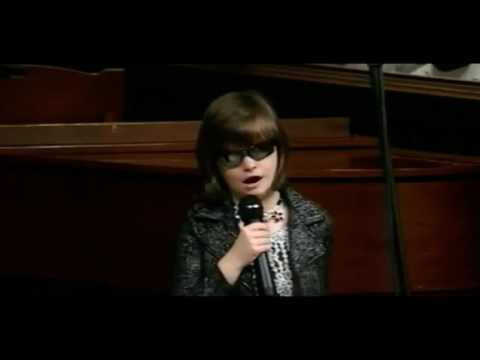
In 1995 a girl was born with undeveloped optical nerves and mild cerebral palsy. She was not expected to live more than at most one year. But God had other plans for her. At age two she began to sing. Her love for singing praises to God has never ceased. And so, in God’s providence she was chosen to sing at the 2017 inauguration interfaith prayer service. And sing she did! Her name is Marlana VanHoose, a little girl, but with a voice.
Meanwhile, the media was busy tracking the protest rallies all around Washington that day. I watched all day and never saw it.
How did the audience that was privileged to watch react? It is worth to listen to it a second time, this time around watching the reaction of the public in attendance, notably Melania Trumps reaction.
After the song Melania led the standing ovation to acknowledge God’s grace, not only for the song, but for the whole day and for the whole presidency.
This is what give us evangelicals hope. She not only sang it, she also sang the third and fourth verses, so often omitted in public settings, especially in interfaith services. Why is that so important?
Let us look at the history of “O store Gud”, and how it came to be the most favored Hymn of at least three presidents before Donald Trump!
Clouds have always been my fascination. They come and go, form and disappear, cool by day and warm by night. But most impressive of all are thunderstorms, forming when the temperature and humidity are high, transport a lot of water vapor to higher elevations, there condensing as rain or ice, coming down, cooling and watering the earth. Clouds and thunderstorms are the thermostat of the earth. Without it the earth would respond like climate models, predicting a sharp temperature rise as carbon dioxide levels increase. The models are all flawed, since they predict a hot spot in the troposphere over the equator, but there is none. The thunderstorms in the tropical doldrums take care of that. “Settled science” instead has settled on ignoring the lack of the hot spot, for to acknowledge it would make the global warming claim invalid.
I thank God for providing us with a thermostat that protects the earth from overheating, and especially for thunderstorms!
Such was the case in July 1885, when Carl Boberg, a 26 year young pastor of a small congregation of the Swedish Missionary society was the honored guest of the ladies’ auxiliary annual picnic, held in a meadow near Mönsteråsviken, (a bay of the Baltic Sea in southeastern Sweden). The day was perfect, the sky was clear, pleasant temperatures, the cows were grazing on the meadow, the birds were singing, in short, a pastoral idyll. Then it happened. In a few short minutes thunderclouds appeared out of nothing. There was no time to go home, so they all sought shelter in a barn close by. The rain came down hard, and lightning struck a nearby tree. Then as suddenly as it started the rain stopped and all was calm. In Sweden it turns much cooler after a thunderstorm, and the birds sing like they got a new lease on life.
They all went home, and the young pastor pondered the events of the day. He
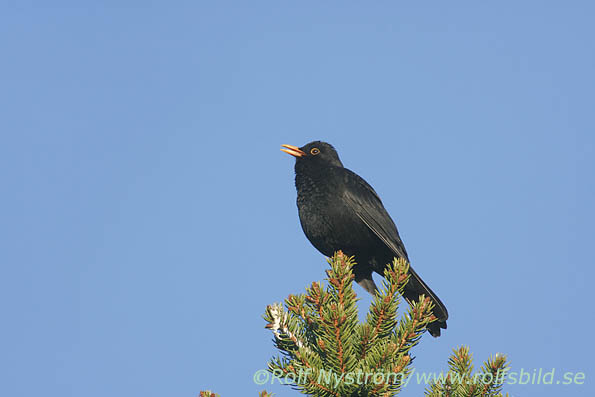
080419-11, digital 28,8 mb RAW, 12-00 Koltrast, Turdus merula Uppland
heard the Koltrast singing its melodic, beautiful drill
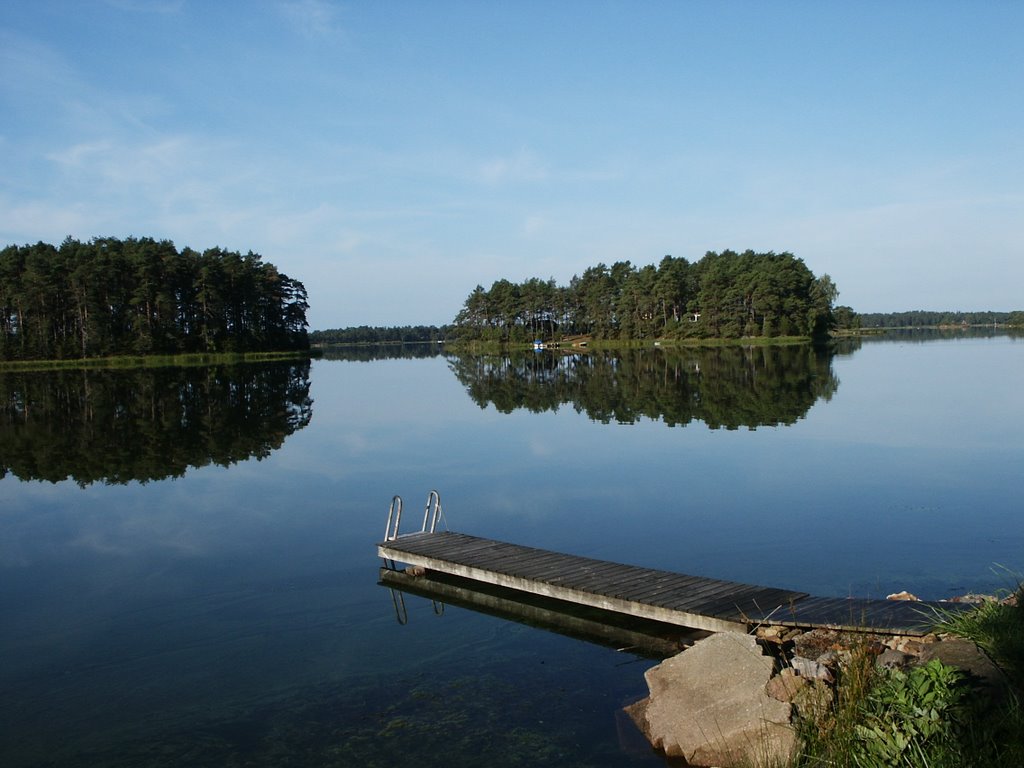
and in a distance he heard the church bells ringing from Kronobäck’s church. The bay was calm like a mirror, and inspired he started penning the song “O store Gud”. Here are the first four verses in Swedish:
O store Gud, när jag den värld beskådar Som du har skapat med ditt allmaktsord Hur där din visdom väver livets trådar Och alla väsen mättas vid ditt bord /: då brister själen ut i lovsångs ljud: O store Gud, o store Gud!
När jag hör åskans röst och stormar brusa Och blixtens klingor springa fram ur skyn När regnets kalla, friska skurar susa Och löftets båge glänser för min syn – /: då brister själen ut i lovsångs ljud: O store Gud, o store Gud!
När sommarvinden susar över fälten När blommor dofta invid källans strand När trastar drilla i de gröna tälten Vid furuskogens tysta, dunkla rand /: då brister själen ut i lovsångs ljud: O store Gud, o store Gud!
När jag i Bibeln skådar alla under Som Herren gjort sen förste Adams tid Hur nådefull han varit alla stunder Och hjälpt sitt folk ur livets synd och strid /: då brister själen ut i lovsångs ljud: O store Gud, o store Gud!
He continued to write and write of all the mighty works that God has made and what He has given us through His word, and continued long into the night. Before going to bed he had penned over twenty verses. The next Sunday he wove the poem into his sermon. The congregation loved it, but that was about it. Slowly the word got around that the poem was pretty good, and after much editing 9 verses were published in the local newspaper Mönsteråstidningen in 1886. Carl Boberg didn’t make any efforts to publish it further, and was surprised when he heard it sung a few years later to a Swedish folk melody (in 3/4 tempo). This was then published in the periodical “Sanningsvittnet” (witness of the truth) in 1891.
It was translated into German by an Estonian, Manfred von Glehn. Five years later it was translated into Russian by Ivan S. Prokanoff, the Martin Luther of modern Russia. It was published in a book with the title “Cymbals”.
Later, while in the Carpathian Mountains of what is now Western Ukraine the English Missionary couple Mercy and Stuart Hine heard the song sung in Russian, this time as a wandering song in march tempo. He got impressed by God’s great works in the Polish mountains, and as Stuart Hine heard the people singing it on their way to church he penned a translation. This became the first and second verse:
O Lord my God, When I in awesome wonder, Consider all the works Thy Hands have made; I see the stars, I hear the mighty thunder, Thy power throughout the universe displayed.
Refrain: Then sings my soul, My Savior God, to Thee, How great Thou art, How great Thou art. Then sings my soul, My Savior God, to Thee, How great Thou art, How great Thou art!
When through the woods, and forest glades I wander, And hear the birds sing sweetly in the trees. When I look down, from lofty mountain grandeur And see the brook, and feel the gentle breeze.
Refrain:
From now on the English version is different from the Swedish original, and it is time to step back and look at a very brief history of Eastern Europe. Before World War I Eastern Europe was basically under the Russian Tsar. Finland was a grand Duchy under Russia, Estonia, Latvia and Lithuania were separate entities but under Russia. Poland was under Russian rule. Belarus didn’t exist and what is now Ukraine was part Russian and part of the Austrian/Hungary empire. The Russians tried to stamp out the Ukraine language but were only partly successful. Then came the Great War and the world changed. Finland, Estonia, Latvia, Lithuania and Poland and some more became independent states . During the Great War the Russian Revolution started and civil wars broke out. Nowhere was the fighting worse than in what was to become independent Ukraine. Up to six armies were fighting for control, and the corruption was unimaginable. Finally the Bolsheviks took control of Ukraine and Joseph Stalin “restored order”. One of the Bolshevik ideals was to control all production and that included all farming. Ukraine was then known as “the bread basket of Europe”. It was during this time the Hines started their ministry in Ukraine. The collectivization of the farms was disastrous to say the least. Farmers know the right time to sow and harvest, they look at the clouds in the sky, pray and go ahead. This is far more efficient than centrally planning when to sow and harvest by order from bureaucrats in a city far, far away, and so there was famine in both Russia proper and Ukraine. But the Ukrainians had put up a lot of resistance, so Joseph Stalin decided to punish the Ukrainians by taking away all their harvest and dole it out to the starving Russians. This resulted in the Holodomor (death by hunger) and at least 3.9 million Ukrainians died. This was in 1932-33 and the Hines were forced to evacuate to Poland, in what is now South West Ukraine.
This is the origin of the third verse: It was typical of the Hines to ask if there were any Christians in the villages they visited. In one case, they found out that the only Christians that their host knew about were a man named Dmitri and his wife Lyudmila. Dmitri’s wife knew how to read — evidently a fairly rare thing at that time and in that place. She taught herself how to read because a Russian soldier had left a Bible behind several years earlier, and she started slowly learning by reading that Bible. When the Hines arrived in the village and approached Dmitri’s house, they heard a strange and wonderful sound: Dmitri’s wife was reading from the gospel of John about the crucifixion of Christ to a houseful of guests, and those visitors were in the very act of repenting. In Ukraine (as I know first hand!), this act of repenting is done very much out loud. So the Hines heard people calling out to God, saying how unbelievable it was that Christ would die for their own sins, and praising Him for His love and mercy. They just couldn’t barge in and disrupt this obvious work of the Holy Spirit, so they stayed outside and listened. Stuart wrote down the phrases he heard the Repenters use, and (even though this was all in Russian), it became the third verse that we know today: And when I think, that God, His Son not sparing; Sent Him to die, I scarce can take it in; That on the Cross, my burden gladly bearing, He bled and died to take away my sin.
Refrain:
The second world war broke out, and the Hines were forced to return back to England, but they continued their ministry. The fourth verse was was added by Stuart Hine after the Second World War had ended. His concern for the exiled Polish community in Britain, who were anxious to return home, provided part of the inspiration for Hine’s final verse. Hine and David Griffiths visited a camp in Sussex, England, in 1948 where displaced Russians were being held, but where only two were professing Christians. The testimony of one of these refugees and his anticipation of the second coming of Christ inspired Hine to write the fourth stanza of his English version of the hymn. According to Ireland: One man to whom they were ministering told them an amazing story: he had been separated from his wife at the very end of the war, and had not seen her since. At the time they were separated, his wife was a Christian, but he was not, but he had since been converted. His deep desire was to find his wife so they could at last share their faith together. But he told the Hines that he did not think he would ever see his wife on earth again. Instead he was longing for the day when they would meet in heaven, and could share in the Life Eternal there. These words again inspired Hine, and they became the basis for his fourth and final verse to ‘How Great Thou Art’:
When Christ shall come, with shout of acclamation, And take me home, what joy shall fill my heart. Then I shall bow, in humble adoration, And then proclaim: “My God, how great Thou art!”
Refrain
The complete song was soon published, not in England but in the Soviet Union (in English). The famous Gospel singer George Beverly Shea got hold of it, liked it a lot, but he wanted to change two words in the first verse: Instead of works, he wanted to use worlds, and instead of mighty he wanted to use rolling. Very reluctantly Stuart Hine agreed, but only for use in the Billy Graham Crusades. It was first sung in Canada in 1955.
It became so popular that in Billy Graham’s 1956 New York Crusade it was sung at all 99 events, and from there the song spread throughout all the world, even back in Sweden where the new version became the popular one. One of the visitors to this Crusade was the little boy Donald Trump, who went with his Father and Mother and Brother (and Sisters?) to listen. God’s word never returns void.
Years have passed since Donald Trump was inaugurated. This is one exchange of views he had with Jens Stoltenberg, Secretary General of NATO:
The main stream media interpreted this as President Trump wanted to weaken NATO
Joe Biden is now President. Again Ukraine is the center of events, and Putin has decided to invade and subdue Ukraine because they decided to direct their corruption to the West rather than go along with the corruption of Russia. The battle of Kyiv is in its third day, and the people of Kyiv has decided to battle it out rather than surrender. It is beginning to look more like the battle of Stalingrad in WW II where the citizens fought and prevailed, so Germany could not get at the Russian oil in Baku. The Ukrainians hatred for Russia is that great. They remember the Holodomor as told them by their grandparents.
Putin seems to have miscalculated badly. He had his eyes on quickly absorbing Ukraine, then taking the Baltic countries, and maybe even Poland. He is getting more and more desperate and has begun to threaten Finland, and even Sweden to not even think of joining NATO.
The people of Ukraine are joining the military, all males 18 to 60 are forbidden to leave the country, forced to join the defense forces in one form or another, and even many women are joining. They are issued a gun, mostly AR 15 or equivalent and some ammunition. What they lack is military training, so the major purpose is to prevent an easy takeover of the cities. There will be many lives shed. When I saw on the TV the heart rendering farewells of the men separating from their loved ones, knowing full well they may never see each other again in this life, the fourth verse of “how great thou art” flashed back in my mind, and when Putin threatened even neutral Sweden, I realized the song had made its journey around the world, and I realized that after the thunder, the still small voice of the Koltrast singing: God is still in charge, but we must still do what we can, and above all, pray for a revival and a great awakening. As the song was sung in Billy Graham’s Crusades to about two billions all around the world, so will our prayers be a part of the greatest revival and awakening the world has ever seen.