“There are three things I have learned never to discuss with people…religion, politics, and the Great Pumpkin.” Linus from Peanuts.
Author: lenbilen
Retired engineer, graduated from Chalmers Technical University a long time ago with a degree in Technical Physics. Career in Aerospace, Analytical Chemistry, computer chip manufacturing and finally adjunct faculty at Pennsylvania State University, taught just one course in Computer Engineering, the Capstone Course.
Acts 17:1-15. Paul and Silas arrived in Thessalonica, preached in the Synagogue, many people were converted, the Jews didn’t like it and a crowd attacked Jason’s home. But in Berea they were welcomed: “These were more noble than those in Thessalonica, in that they received the word with all readiness of mind, and searched the scriptures daily, whether those things were so.” The net result though was similar to what happened in Thessalonica, so Paul was escorted to Athens.
2 Chronicles 6 records Solomon’s speech when the work was completed and Solomon’s prayer of dedication.
2 Chronicles 7. Solomon dedicated the Temple, and God appeared to Solomon a second time, promising “If my people, which are called by my name, shall humble themselves, and pray, and seek my face, and turn from their wicked ways; then will I hear from heaven, and will forgive their sin, and will heal their land.”
Acts 16:16-40. In Philippi Paul and Silas were put in prison, but while singing praises to God their chains fell off, the Philippian Jailer, rather than killing himself asked “Sirs, what must I do to be saved?” And they answered, “Believe on the Lord Jesus Christ, and thou shalt be saved, and thy house.” Since Paul and Silas were Roman citizens they were asked to leave secretly, but they went to Lydia’s house instead. After that they departed.
2 Chronicles 3. Solomon did build the temple to man’s standard, six hands to a cubit. He even used gold nails instead of iron nails in the ceiling, far more gold than was called for in the tabernacle.
2 Chronicles 4 contains a listing of the temple furnishings.
2 Chronicles 5. The ark was brought into the Temple, and the glory of the LORD filled the Temple.
Acts 16:1-15. Timothy joined Paul and Silas in Lystra and in Troas Paul received “the Macedonian Call”. Lydia, a new convert was baptized at Philippi.
2 Chronicles 1. Solomon asked for wisdom, he received it and more, God also gave him economic and military power.
2 Chronicles 2. Solomon Prepared to build the temple, took inventory of all things collected and tallied the number of constricted aliens to do the work.
Psalm 45, of the Sons of Korah, a Wedding Song. C.S. Lewis saw this psalm pointing to Christmas: “The birth of Christ is the arrival of the great warrior and the great king. Also of the Lover, the Bridegroom, whose beauty surpasses that of man. But not only the Bridegroom as the lover, the desired; the Bridegroom also who makes fruitful, the Father of children still to be begotten and born.” (C.S. Lewis, as cited in Willem VanGemeren)
Acts 15. There was much ado about circumcision, and the believers decided to settle the issue at the Council at Jerusalem, which led to the Jerusalem decree, (in short: Abstain from fornication and from blood). Barnabas and Paul argued about Mark, so they split up, and Paul took Silas and embarked on the second missionary journey.
Proverbs 7. Keep the Law, Seek wisdom and above all, stay away from harlots! They will use every trick to get you!
Psalm 44. Of the sons of Korah. It is a Psalm recounting the great victories God gave the Israelites when they followed God, and the humiliating defeats they suffered when they did not. Yet the psalmists were trusting God and claimed they had not forgotten the Lord and ended with an urgent plea for help.
Greta Thunberg, 17; Times person of the year 2019 was at it again, this time in Davos at the annual World Economic Forum. She was allowed to give a 30 minute speech to all the dignitaries assembled, who had generated 18,090 metric tons of CO2 (source CNN) getting there in their jets. Her message was:
“Let’s be clear. We don’t need a ‘low carbon economy.’ We don’t need to ‘lower emissions,” … “Our emissions have to stop if we are to have a chance to stay below the 1.5-degree target,” (The New York Times.)
We have experienced more than a 50% increase in CO2 levels since the beginning of industrialization. In the last 32 years the level has risen 20%, from about 350 ppm to 421 ppm. This is what scares people. Is is time to panic and stop carbon emissions altogether as Greta Thunberg suggested?
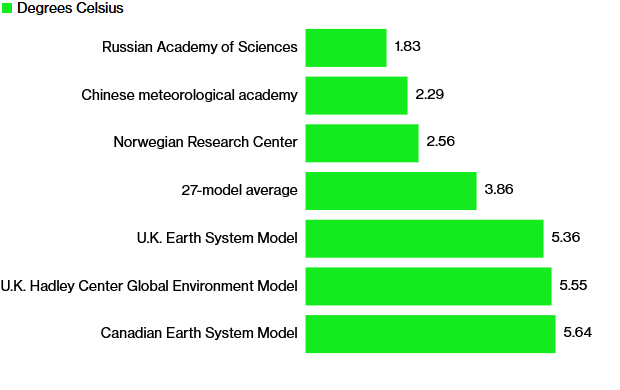
As if on cue the climate models have been adjusted, and they suddenly show a much higher rate of temperature increase, in this case what is supposed to happen to global temperatures for a doubling of CO2 from pre-industrial times, from 270ppm to 540ppm.
Source: Mark D Zelinka et al. ” Causes of higher Climate sensitivity in CMIP6 models” Geophysical Research Letters.
There are two ways to approach this problem. The models make certain assumptions about the behavior of the changing atmosphere and model future temperature changes. This is the approach from IPCC for the last 34 years. These models all fail miserably when compared to actual temperature changes.
The other way i to observe what is actually happening to our temperature over time as the CO2 increases. We have over 50 years of excellent global temperature data, so with these we can see where, when and by how much the earth has warmed.
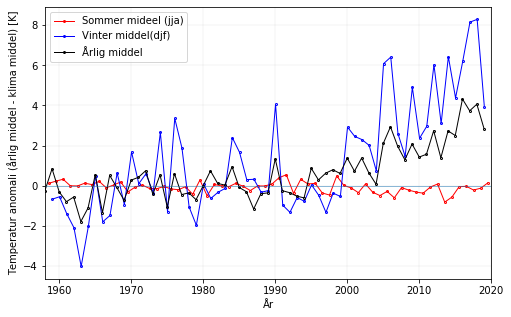
The most drastic temperature rise on earth has been in the Arctic above the 80th latitude. In the winter of 2018 it was 8C above the 50 year average. Since then it has come down to the more normal 4C increase. See charts from the Danish Meteorological Institute:
Summer: red, Jun,Jul, Aug. Winter: green, Dec, Jan, Feb Yearly: black
Note, there are no increase at all in the summer temperatures!
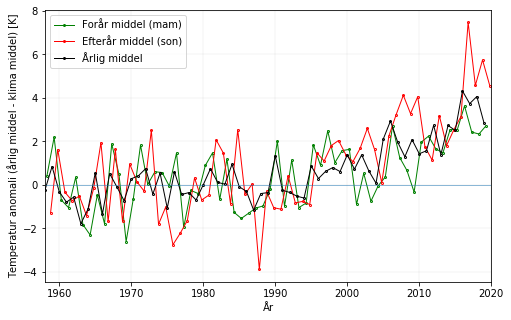
Spring: green, Mar, Apr, May. Fall: red, Sep Oct, Nov. Yearly: black
The fall temperature saw an increase of 4C and the spring temperature saw an increase of about 2.5C.
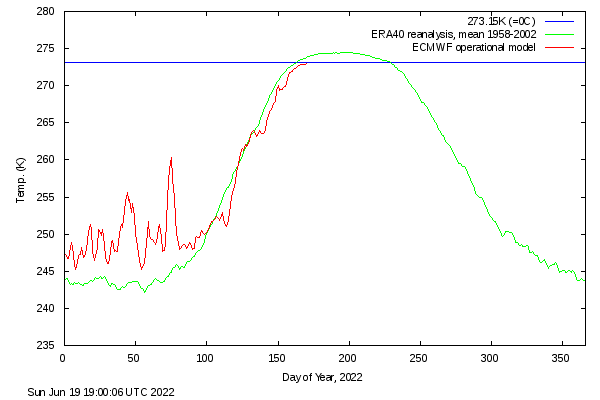
The 2022 winter saw an about 4c increase. The Spring temperatures have from the 10th of March were below or very close to the 1958 – 2002 average. Early Summer temperatures have so far been about 1C below normal. Source: DMI.
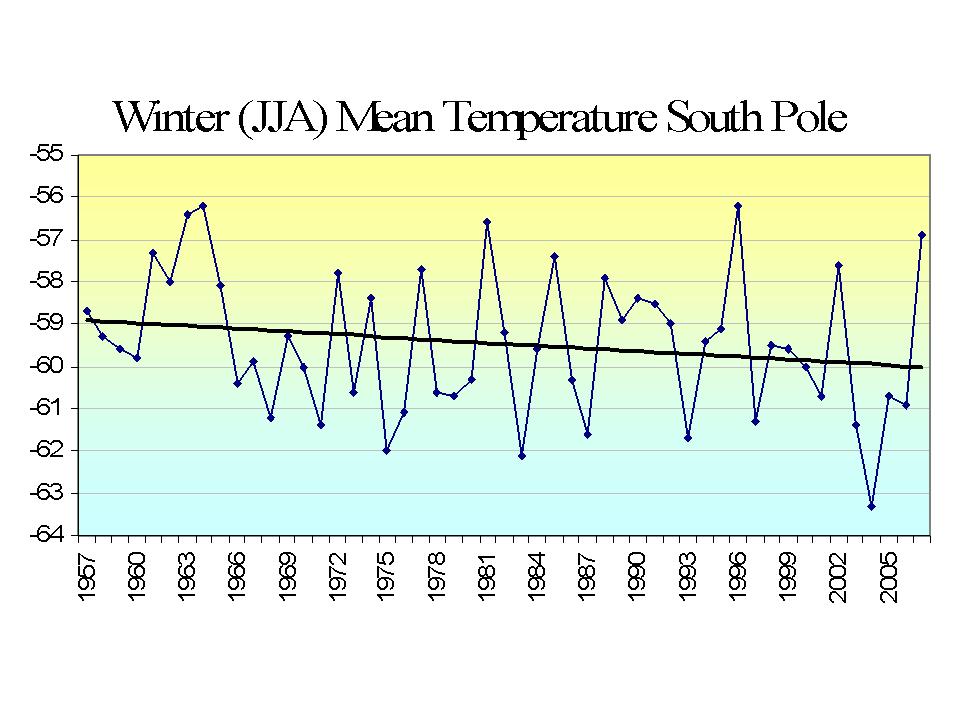
There seems to be no cause for immediate panic with the Arctic temperatures. If anything, they seem to moderate. In Antarctic on the other hand the temperatures may even be decreasing! The Amundsen Scott – South Pole weather station, the average temperature of Winter season 2021 (April 2021 – September 2021) reached only -61,0°C / -78°F, which is the coldest value in all-time history! This was 2,5°C /4.5°F degrees lower than the most recent 30-year average at this remote station.
Why are the temperatures not behaving like the models predict?
To get the answer we must study molecular absorption spectroscopy and explain a couple of facts for the 97% of all scientists who have not studied molecular spectroscopy. IPCC and most scientists claim that the greenhouse effect is dependent on the gases that are in the atmosphere, and their combined effect is additive according to a logarithmic formula. This is true up to a certain point, but it is not possible to absorb more than 100% of all the energy available in a certain frequency band! For example: If water vapor absorbs 90% of all incoming energy in a certain band, and CO2 absorbs another 50% of the energy in the same band, the result is that 95% is absorbed, (90% + 50% * (100% – 90%)), not 140%, (90% + 50%).
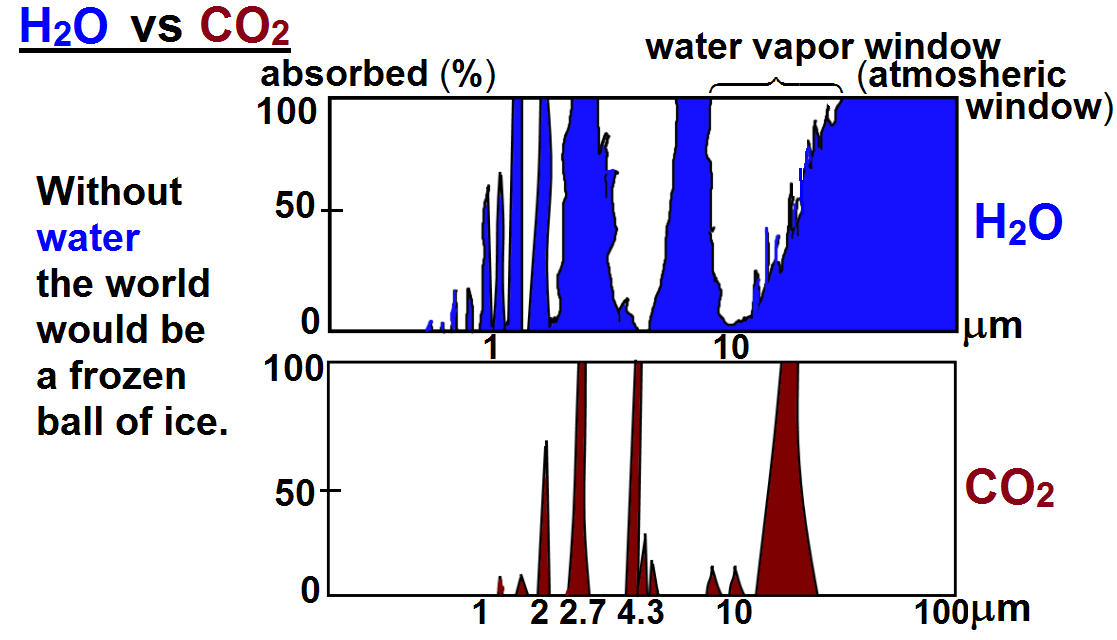
The following chart shows both CO2 and H2O are absorbing greenhouse gases, with H20 being the stronger greenhouse gas, absorbing over a much wider spectrum, and they overlap for the most part. But it also matters in what frequency range s they absorb.
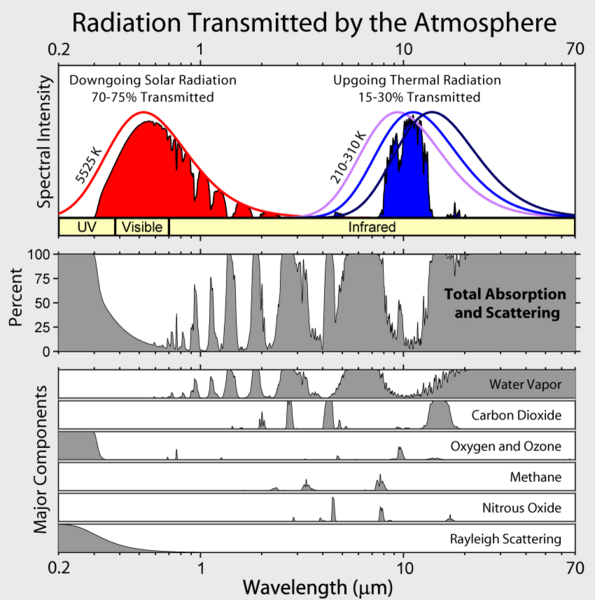
For this we will have to look at the frequency ranges of the incoming solar radiation and the outgoing black body radiation of the earth. It is the latter that causes the greenhouse effect. Take a look at this chart:
The red area represents the observed amount of solar radiation that reaches the earth’s surface. the white area under the red line represents radiation absorbed in the atmosphere. Likewise, the blue area represents the outgoing black body radiation that is re-emitted. The remaining white area under the magenta, blue or black line represents the retained absorbed energy that causes the greenhouse effect.
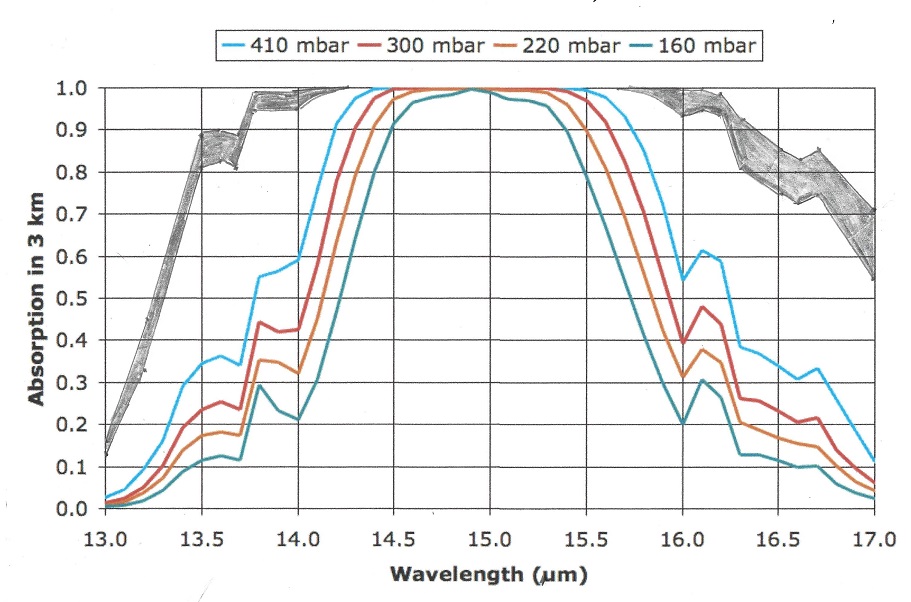
Let us now take a look at the Carbon Dioxide bands of absorption, at 2.7, 4.3 and 15 microns. Of them the 2.7 and 4.3 micron bands absorb where there is little black body radiation, the only band that counts is at 15 microns, and that is in a band where the black body radiation has its maximum. However it is also in a band where water vapor also absorb, not as much as CO2,only about 20% to 70% as much. The important thing is that in the frequency band of 14.5 to 15.5 micron CO2 absorbs all the energy available in that spectral range, and it also did it before industrialization when CO2 levels were one third less than today!
The grey area is the difference between total pre-industrial absorption and today, less than 5 % added absorption in the 13 to 17 micron band. Norice that total absorption from ground level to thermopause cannot exceed 100%
From this we can see that increasing CO2 levels is not the cause of climate change, only a very minor player. How about Methane?
Methane has only two major absorption bands, one at 3.3 microns, and the other at 8 microns. The 3,3 micron band is where incoming radiation is negligible, and so is outgoing black-body radiation. The 8 micron band is where water vapor is dominant, co Methane turns out to be the don’t care gas.
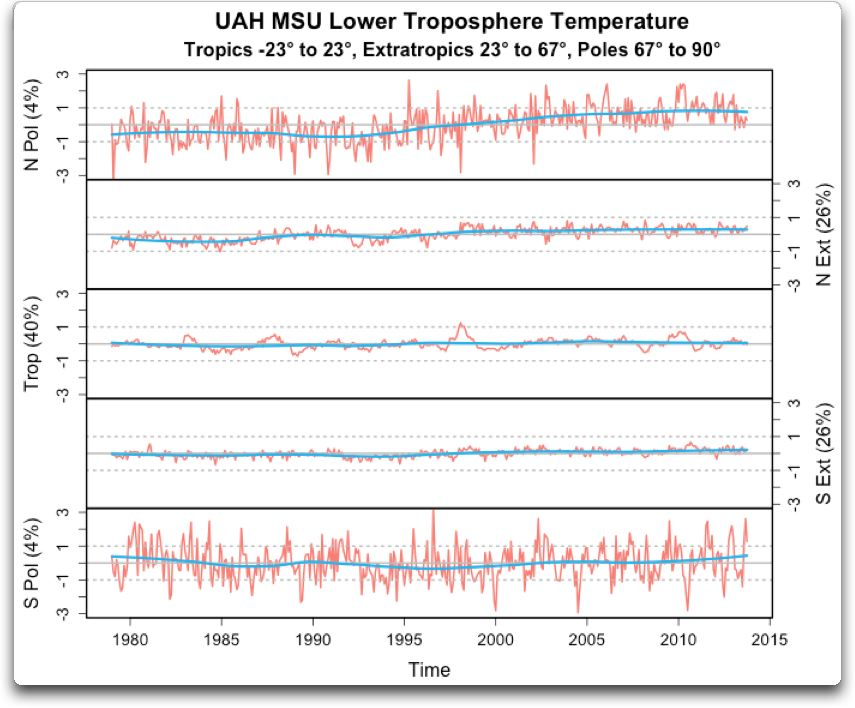
Water vapor or absolute humidity is highly dependent on the temperature of the air, so at 30C there may be 50 times as much water vapor, at 0C there may be ten times as much water vapor, and at -25C there is more CO2 than water vapor. At those low temperatures the gases are mostly additive. In the tropics with fifty times more water vapor than CO2, increased CO2 has no influence on the temperature whatsoever. Temperature charts confirm this assertion:
Here the temperature in the tropics displays no trend whatsoever. It follows the temperature of the oceans, goes up in an el niño and down in a la niña. The temperature in the southern hemisphere shows no trend. In the northern temperate region there is a slight increase, but the great increase is occurring in the Arctic. There is no increase in the Antarctic yet even though the increase in CO2 is greater in the Antarctic and the winter temperature in the Antarctic is even lower than in the Arctic. So CO2 increase cannot be the sole answer to the winter temperature increase in the Arctic.
There is an obvious answer. When temperatures increase the air can contain more moisture and transport even more moisture from the tropics,all the way to the arctic, where it ends up as snow. Is the snow increasing in the Arctic?
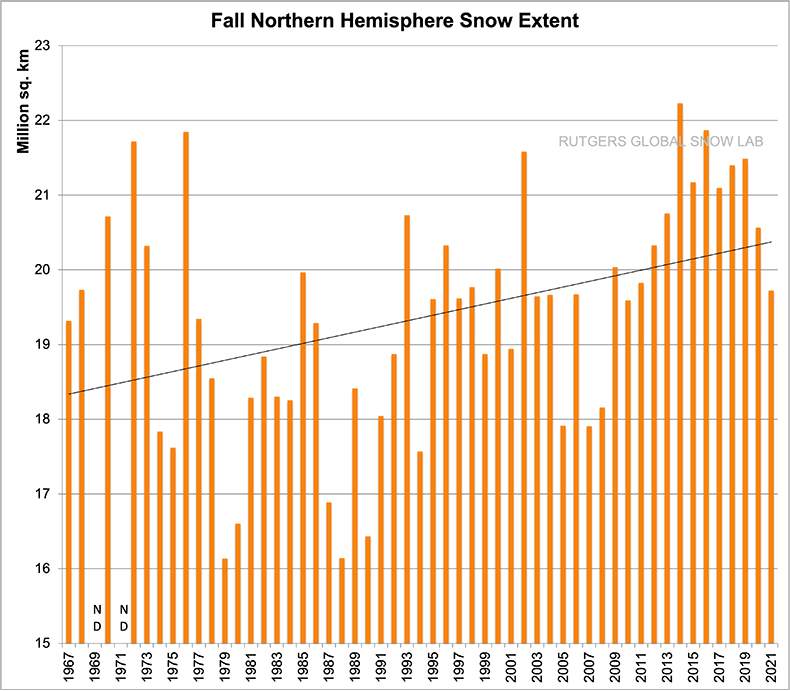
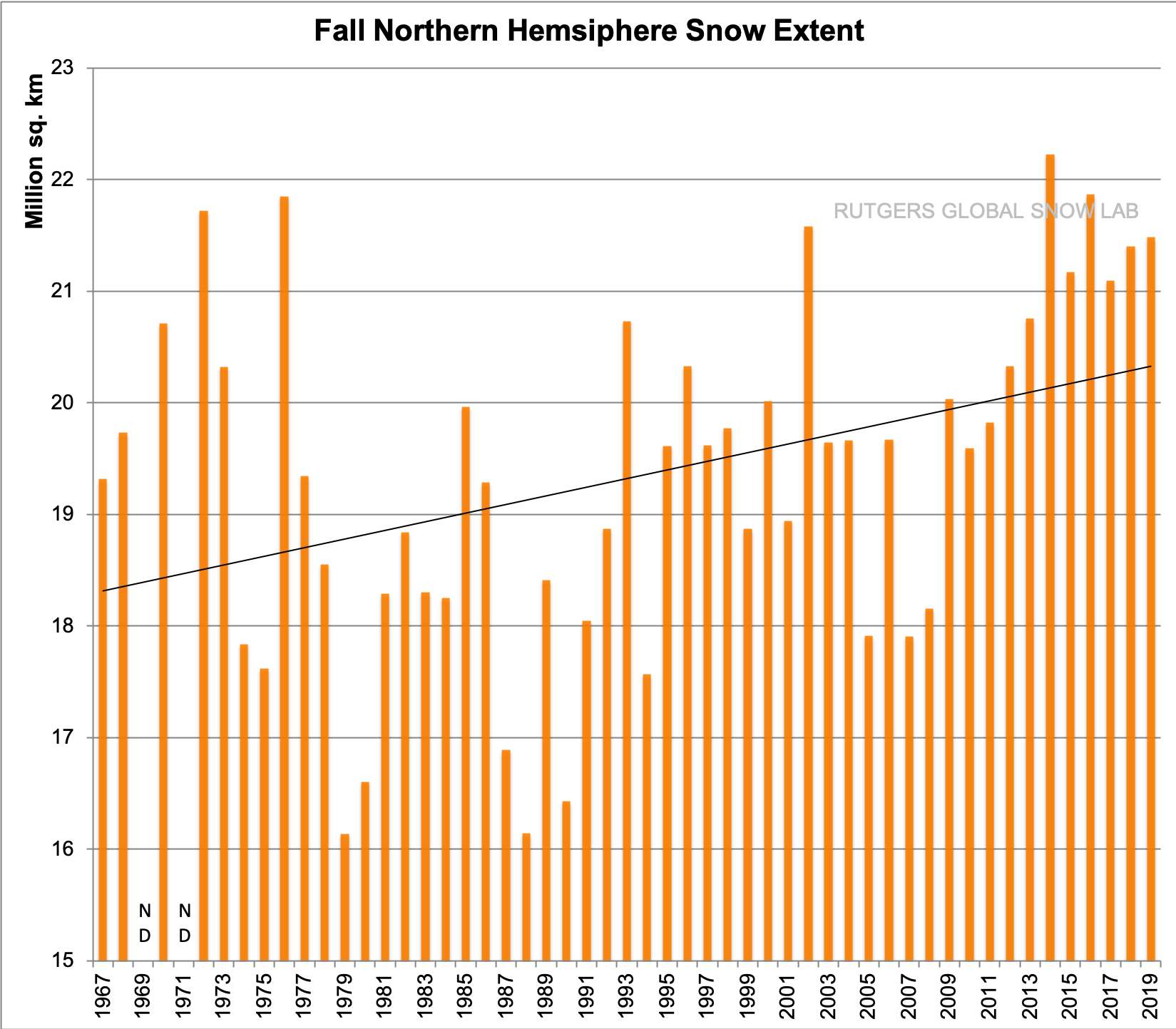
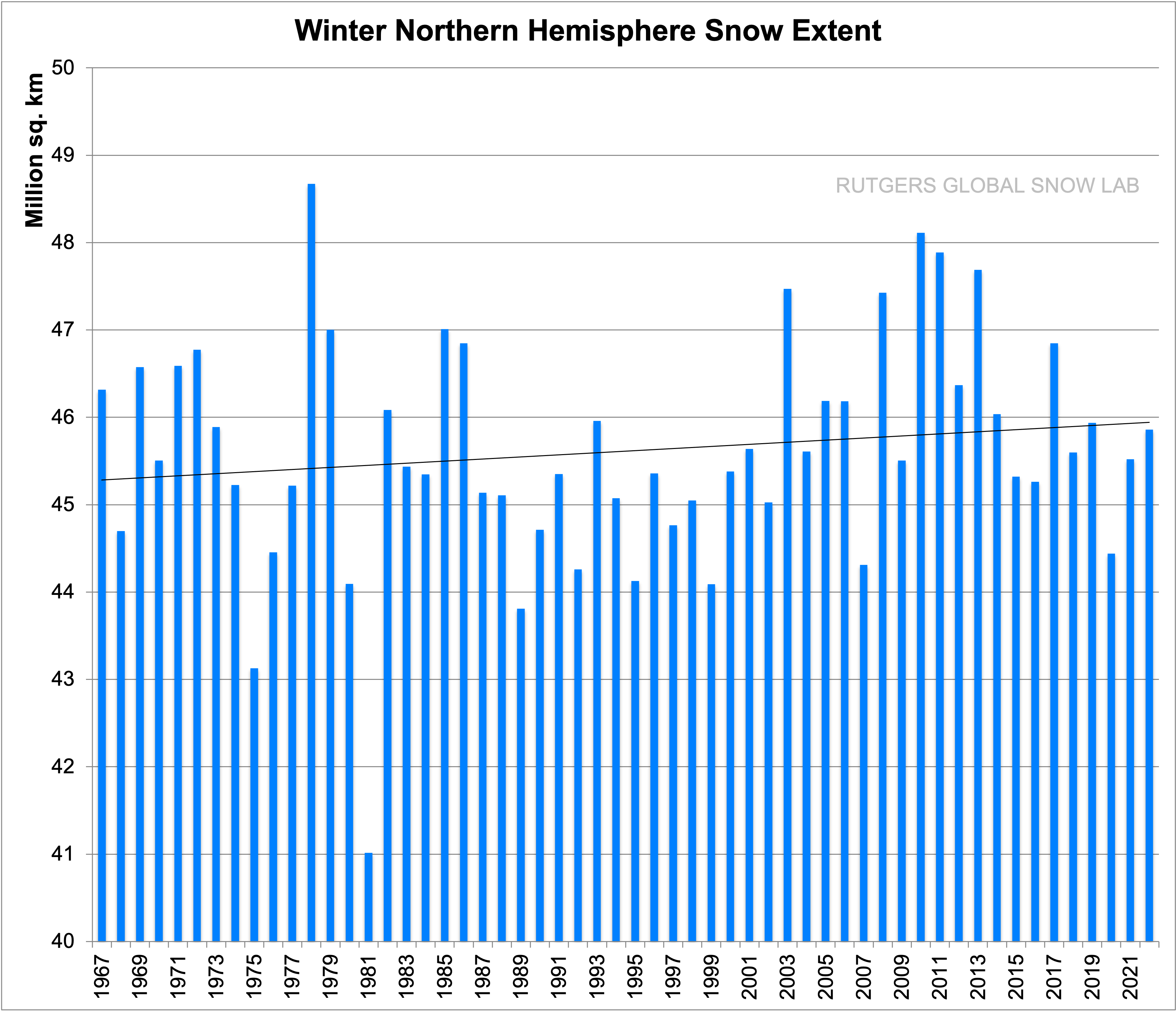
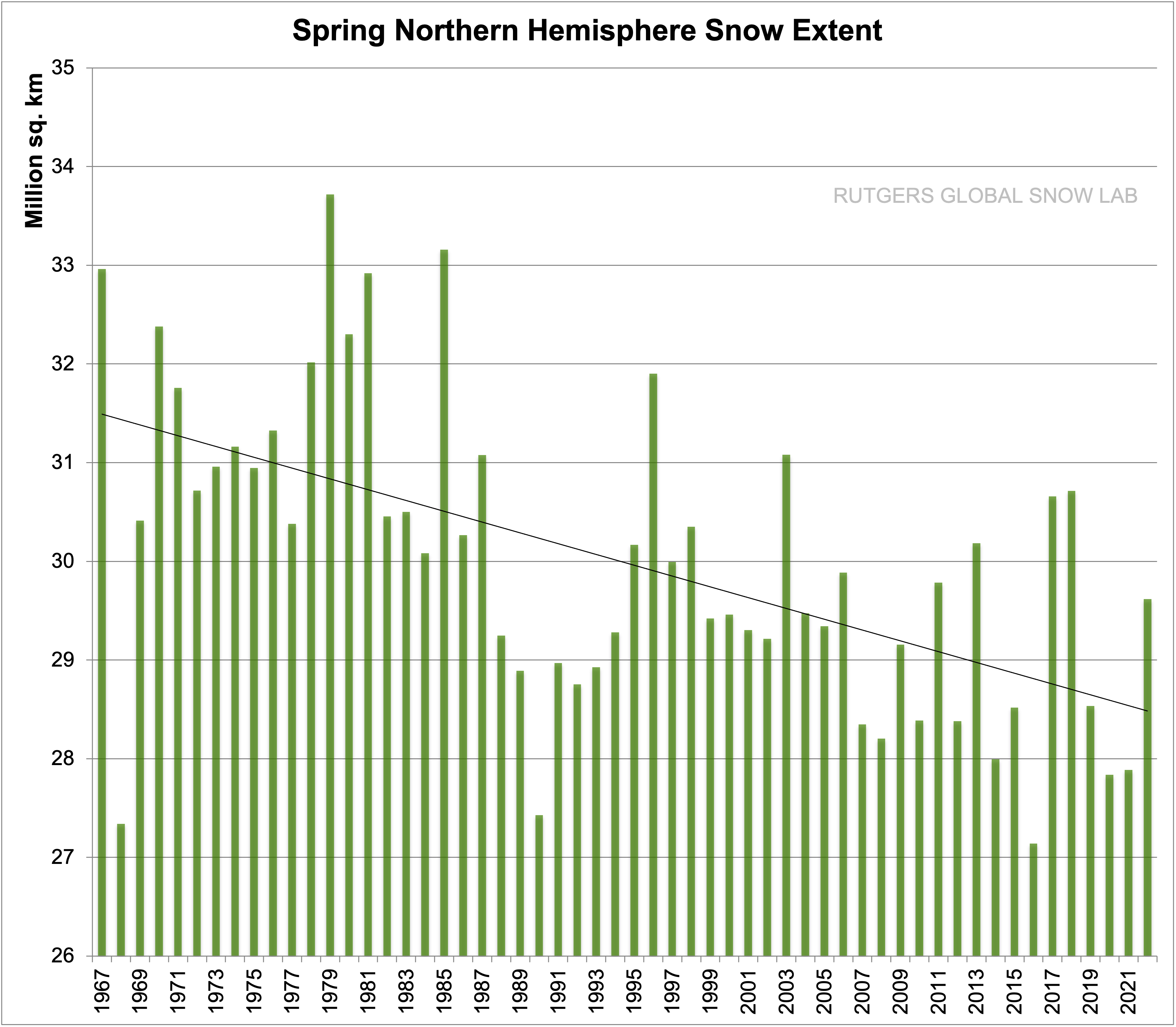
Let us see what the snow statistics show. These are from the Rutgers snow lab.
The fall snow extent is increasing, and has increased by more than 2 percent per year.
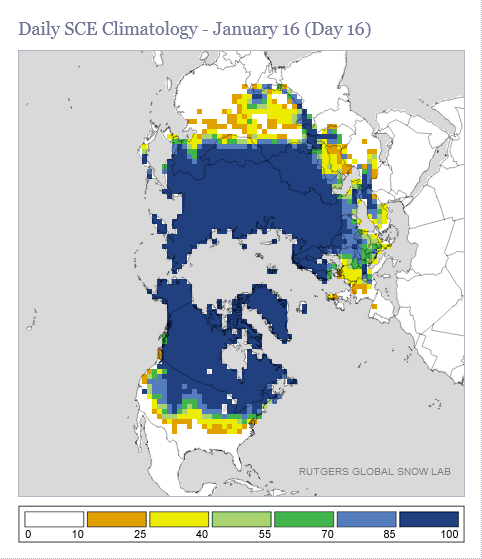
The winter snowfall has also increased but only by 0.04 percent per year. The snow covers all of Russia, Northern China, Mongolia, Tibet, Kashmir and northern Pakistan, Northern Afghanistan, Northern Iran, Turkey, Part of Eastern Europe, Scandinavia, Canada, Alaska, Greenland and part of Western and Northern United States.
Jan 16,2022
In the spring on the other hand the snow pack is melting faster, about 1.6 percent less spring snow per year. One of the major reasons for an earlier snow melt is that the air is getting dirtier, especially over China, and to some extent Russia. The soot from burning coal and mining dust changes the albedo of the snow. The soot is visible on old snow all the way up to the North Pole. The other reason is that the North Pole is getting warmer. In the fall and winter it is mostly due to increased snowfall, but in the spring, as soon as the temperatures rise over the freezing point, melting occurs.
So the warming of the poles, far from being an impending end of mankind as we know it, may even be beneficial. Warmer poles in the winter means less temperature gradient between the poles and the tropics, leading to less severe storms. They will still be there, but less severe.
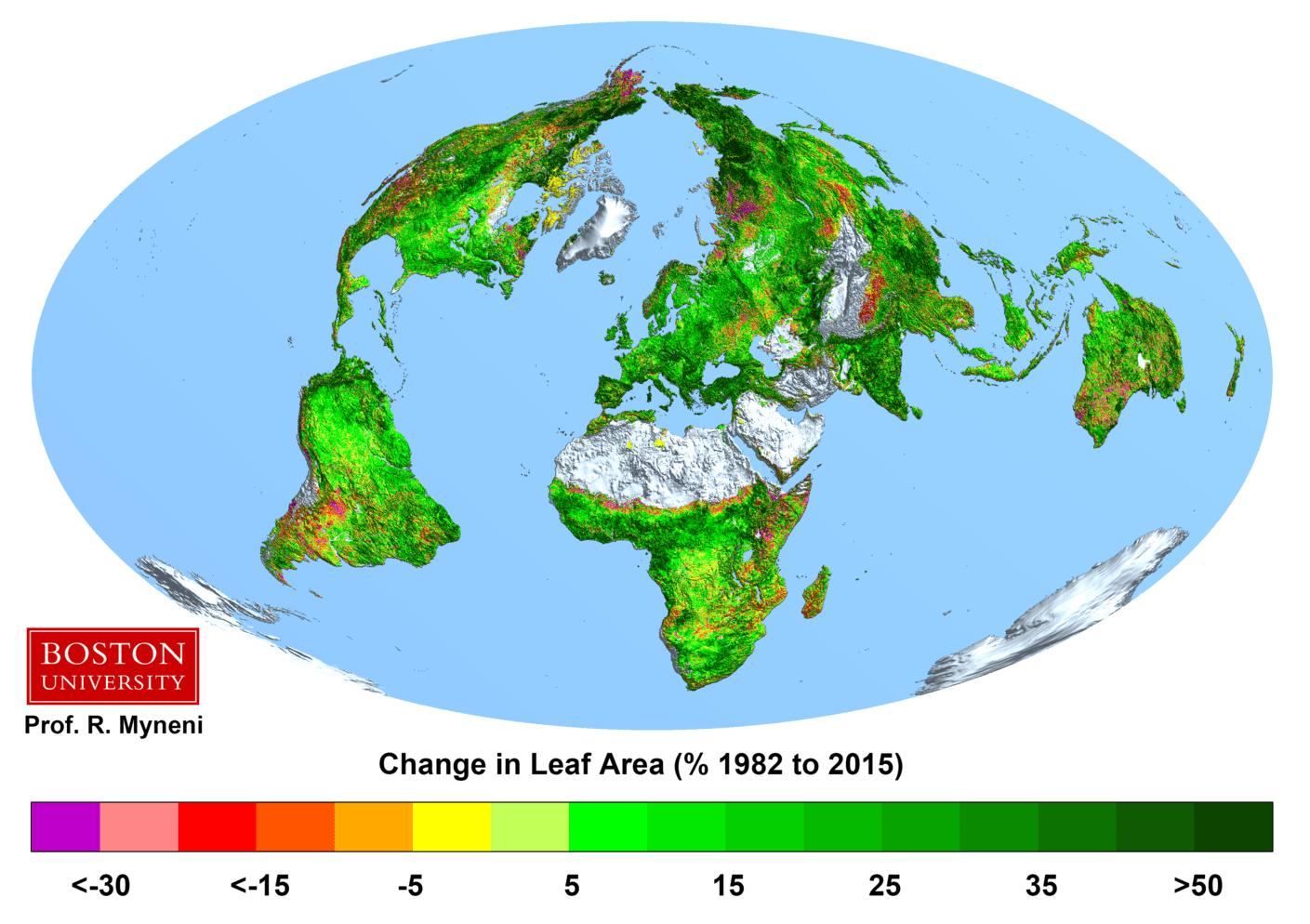
There is one great benefit of increased CO2, the greening of the earth.
Thanks to this greening, done with only the fertilizer of CO2 the earth can now keep another 2 billion people from starvation, not to mention what it does for plants and wildlife.
Refocusing our attention on the South Pole, it set a new Winter half year record average temperature of -61 degree Celsius. At those temperatures CO2 is the dominant greenhouse gas, CO2 vapor is less than one tenth of the CO2. This means that most of the Greenhouse effect will come from CO2,
As CO2 is increasing, winter temperatures at the South Pole is decreasing. This means that CO2 cannot be a major factor in climate change, if anything, it could result in lower temperatures.
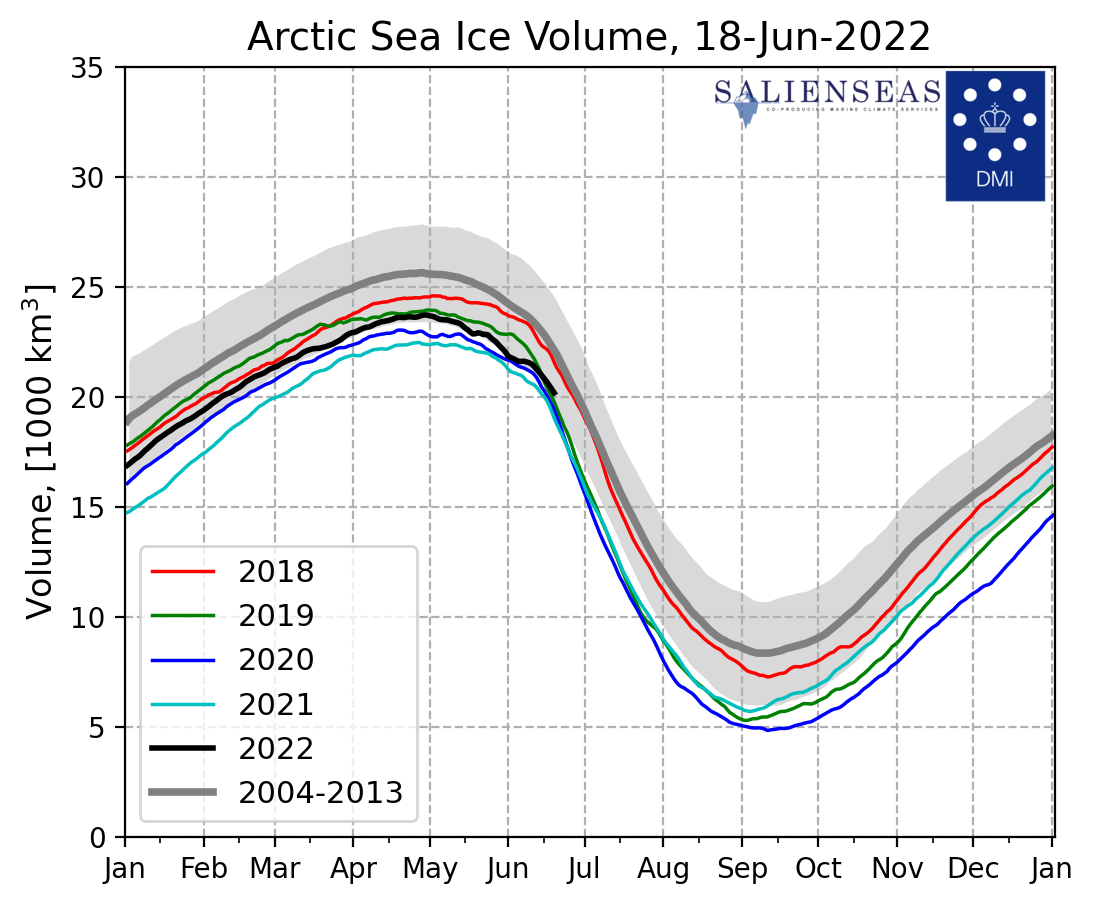
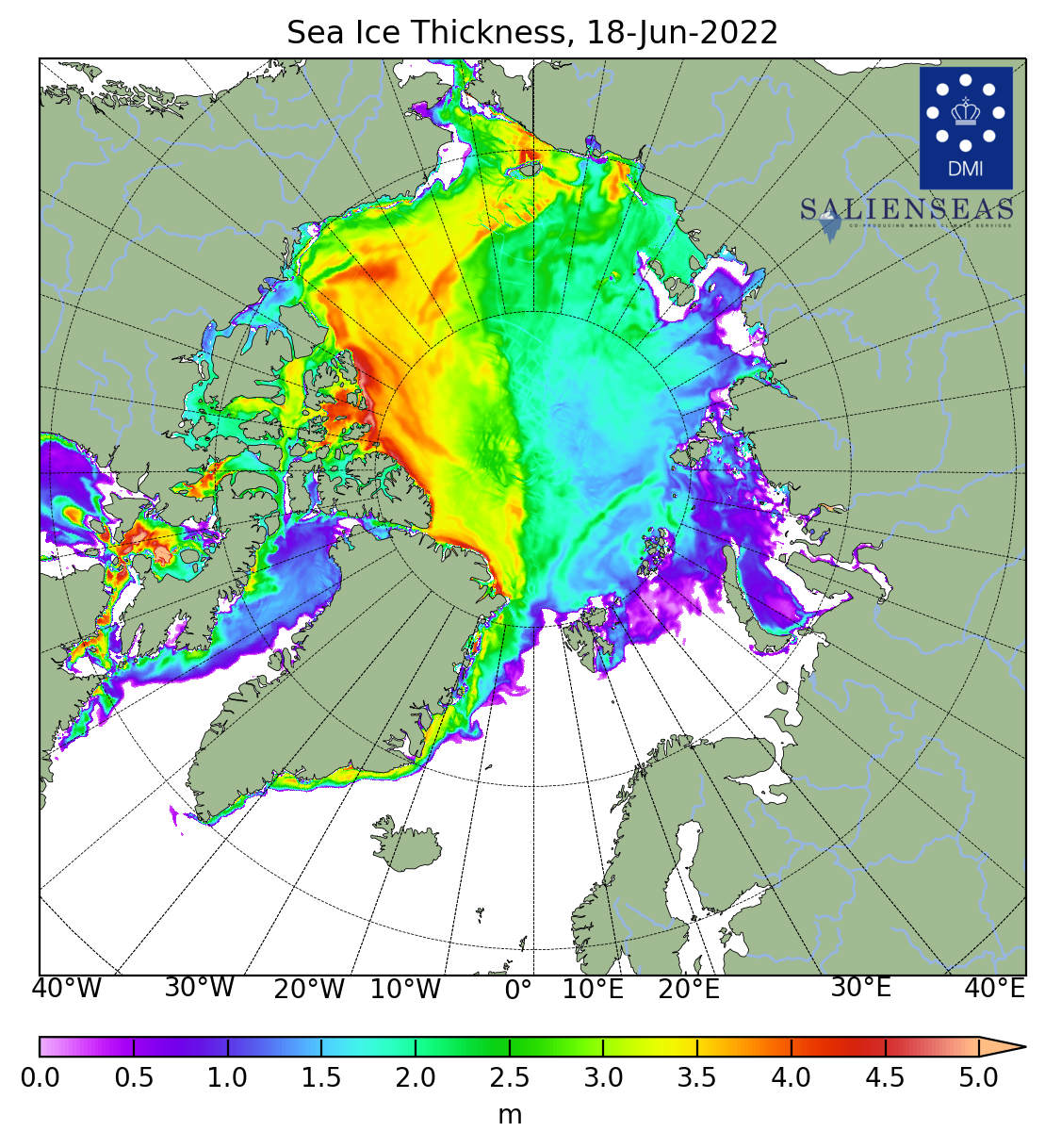
Now revisit the temperatures in the Arctic, what is happening to the ice cover:
The current ice volume is higher than the previous 3 years but not yet back to normal.The interesting thing in this picture is that the multi-year ice is increasing.
The Arctic Spring temperatures are the coldest in many years. So far it is only weather, but it is probably an early warning of the coming cooling trend.
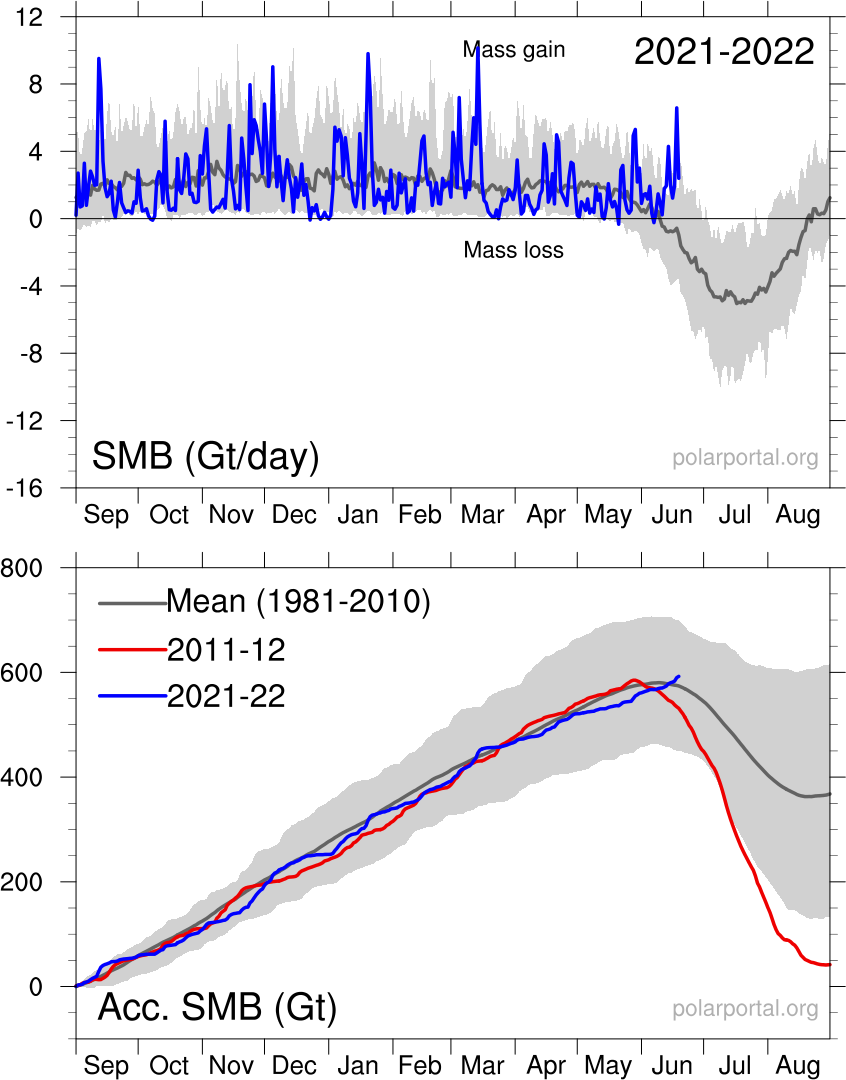
One interesting trend is the increasing ice on Greenland. 2012 was the uear of maximum ice-melt and the prediction was that the arctic may be ice-free in September of 2015, or at least before 2020. Since then Greenland ice is recovering and some glacier have started growing again. Today’s snapshot:
19 June 2022
The delay of the melting season is so far only weather, not yet climate change.
The greening of the world thanks to rising CO2 is substantial, but there are areas that are becoming desertified. In North America the concern is for the American Southwest by using up the aquifers and depleting the reservoirs.
The source of the climate change is not rising CO2 levels, not Methane. It is land use changes, the depletion of aquifers, especially between the tenth and the fortieth latitude. This leads to drying up the land and diminishing river flows. Exhibit A: The Colorado River and the depletion of Lake Mead and Lake Powell.
Having said that, I am still a conservationist. Coal, oil and gas will run out at some time, and I for one would like to save some for my great grandchildren, not yet born. In addition I would like to minimize the need for mining, which can be quite destructive.
We need to take a good look at our energy alternatives. Wind and Solar are good bets, but when the sun doesn’t shine and the wid doesn’t flow we need enormous battery parks to make up for the lack of solar and wind. For now this is provided mostly by natural gas, and coal. Until that is solved it makes no sense to convert the vehicle park to electric power.
The obvious solution is to switch from coal and gas to nuclear power. The total life cycle need of mined material is about 10% of a coal fired plan. The best solution is to switch to Liquid Fluoride Thorium Reactors. They are much cheaper to manufacture than conventional nuclear power. a 100 MW LFTR can be made on an assembly line and be shipped to site in 3 conventional large truck containers.
Here are the many cases why Thorium Nuclear Power is the only realistic solution to the world’s energy problems.
Acts 14. Paul went to Iconium, preached the Gospel and the Jews and some Gentiles threatened to stone him, so he fled to Lystra and they did. He and Barnabas then escaped to Derbe. From there they returned to Lystra, Iconium and Pisidian Antioch where Paul strengthened the converts, after which they went back to Attalia and sailed back to Antioch where they gave a report on their first missionary journey.
1 Chronicles 28. David instructed Solomon how to build the Temple, complete with promises and warnings for the future.
1 Chronicles 29 begins with a long list of offerings for building the temple, then is recorded David’s praise to God, after which Solomon was anointed King and finally recorded is the close of David’s reign.
Acts 13:13-52. From Cyprus, Barnabus and Paul went to the Pisidian Antioch. Paul preached Jesus powerfully, almost the whole city wanted to listen, the Jews got jealous and expelled them from the region. As a consequence Paul and Barnabas continued on their journey to Iconium.
1 Chronicles 26 lists the gatekeepers, the treasurers and other officials.
1 Chronicles 27 lists the military divisions, the leaders of the Israeli tribes and other officials.
Acts 13:1-12. Barnabas and Saul began their first missionary journey with preaching on the island of Cyprus where Saul’s name was changed to Paul. Paul rebuked Elymas the sorcerer and God struck him with blindness.
1 Chronicles 24 shows the divisions of the priests, who served tabernacle duties when, and the other Levites, serving as alternates.
1 Chronicles 25 lists the musicians set apart for temple service in 24 divisions for the different times of service.
Acts 12. King Herod persecuted the Church and putting many in prison, even Peter; but Peter miraculously escaped. Herod’s suffered a violent death after giving a speech without giving glory to God.
1 Chronicles 22. David made preparations to build the Temple.
1 Chronicles 23 contains a listing of the Levites and their duties.
Psalm 43. This Psalm may very well be a continuation of Psalm 42. Nevertheless, it is a Psalm of deep depression and yet full of praise and hope.
Acts 11 . The Jews did not like that gentiles could receive the Holy Spirit, but Peter explained God’s Grace. Barnabas went looking for Saul and when found they went together to Antioch. It was there the believers were first called Christians, and it was from there they sent relief to fellow believers in Judea via Barnabas and Saul.
1 Chronicles 19. Wars continued, the Ammonites and the Syrians were defeated.
1 Chronicles 20. Wars went on and on. Rabbah was conquered and the Philistine giants were destroyed.
1 Chronicles 21. David took a census of Israel and Judah. This was a great sin and the LORD gave David three options how the country should be punished. David chose to be in the hands of the LORD, and the nation was punished by being visited by the angel of the LORD. The angel stopped at Araunah’s threshing floor, the future site of the Temple.