With Molten Salt Reactors, a catastrophe like Fukushima cannot happen. It began with a magnitude 9.0 earthquake not far from the Fukushima 6 Nuclear reactors complex. The impact was a magnitude 6.8 earthquake and the operators immediately scrammed the safety rods to stop all the reactors. This succeeded! The reactors were designed with earthquakes in mind, and they passed the test. The backup power started up successfully so the cooling pumps could operate. There was one major problem though. The earthquake was so bad that the water in the spent fuel holding tanks splashed out and exposed the spent fuel rods to air, releasing enough radioactivity to make entering the buildings impossible.
The water pumps worked for a while, but then came the tsunami. All the reactors were inside a tsunami wall, so far, so good. But the fuel storage tanks for the fuel for the backup power generators were outside the tsunami wall and were washed away. The batteries were only supposed to last until backup power was established, and with complete power loss and water circulation ended the meltdown started. This disaster was even bigger than Chernobyl and contamination is still spreading.
Japan has spent roughly 1 trillion yen ($7.3 billion) annually on the damage caused by the meltdowns at the Fukushima Daiichi nuclear power plant that occurred 12 years ago, and the final price tag is still uncertain.
In addition, the Japanese government has arranged 13.5 trillion yen to pay for reparations and cleanup efforts, with those outlays covered by Japanese government bonds. The state is extending roughly 10 trillion yen to TEPCO to cover compensation costs.
In a molten salt Thorium reactor, when power is cut off in an emergency, only gravity is needed for a safe shutdown, and gravity hasn’t failed us yet.
Acts 18:9-28. Paul left Athens and went to Corinth where he stayed a year and a half, teaching many in the city, among them Priscilla and Acquila. The three of them went to Ephesus, where Paul left Priscilla and Acquila and went to Antioch. Priscilla and Acquila met Apollos, a learned man preaching the baptism of John. “When Aquila and Priscilla had heard, they took him unto them, and expounded unto him the way of God more perfectly. And when he was disposed to pass into Achaia, the brethren wrote, exhorting the disciples to receive him: who, when he was come, helped them much which had believed through grace: For he mightily convinced the Jews, and that publicly, shewing by the scriptures that Jesus was Christ.”
2 Chronicles 15. Asa threw out the idols and repaired the altar before the Temple. People from Israel joined, and thanks to following the LORD Judah had peace until the 35th year of Asa’s reign.
2 Chronicles 16. Asa’s made a treaty with Syria. That was a mistake. Hannai’s Message to Asa was that Asa had not relied on the LORD. Four years later Asa died.
2 Chronicles 17. Jehoshaphat reigned in Judah, they took the Book of the Law around the country and taught the people. The fear of the LORD fell on the surrounding countries, so Judah had peace for years.
Psalm 47, of the Sons of Korah. “Sing praises to God, sing praises“.
With a Molten Salt Reactor, accidents like Chernobyl are impossible. The Three Mile Island accident was bad. The Chernobyl disaster was ten million times worse. Ah yes, I remember it well.
One morning at work, a fellow co-worker, a Ph.D. Chemist working on an Electron Capture Detector, containing a small amount of Nickel 63, came with a surprising question: You know nuclear science, how come the reactors in Chernobyl don’t have a containment vessel? Well- I answered, it is because they are carbon moderated and their failure mode is that they go prompt critical, and no containment vessel in the world can hold it in, so they skip it. He turned away in disgust. A few weeks later my wife’s father died, and we went to Denmark to attend the funeral. The day of the return back to the U.S. we heard that there had been a nuclear incident in Sweden, too much radiation had caused two nuclear power stations to close down. The Chernobyl disaster had happened 26 April 1986, and this was the first time anyone outside of Chernobyl has heard about it, two days later. This was still the Soviet Union, and nothing ever did go wrong in it worthy of reporting.
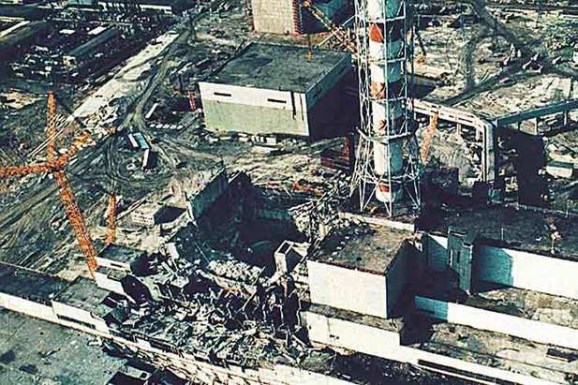
(Photo Courtesy of EBRD)
Notice the gaping hole where the reactor was. The adjacent reactor was not shut down immediately, but continued to operate and deliver power for days. During the invasion of Ukraine in 2022, the still-very-real health risks inherent to lingering around certain parts of the Chernobyl Exclusion Zone just didn’t sink in with Russian soldiers and their commanding officers based in Belarus. Radiation sunk in, though—particularly after Russian troops dug into the zone’s heavily irradiated Red Forest. And today, some soldiers are still falling sick, according to diplomatic sources cited by the UK journal The Independent.
The radiation cloud immediately following the accident continued to spread, and was first noticed in Sweden, and the SLV immediately declared reindeer meat, wild game and inland fish with a 300-bequerel/kilogram (Bq/kg) count or higher to be unsafe for human consumption and therefore unmarketable. 75% of all reindeer meat was deemed unfit for human consumption, and this played havoc with the Sami population.
(But the carbon moderated Uranium reactors are the most efficient in producing Pu-239 the preferred nuclear bomb material.)
As I mentioned before, the failure mode of carbon moderated nuclear power plants is that they can go prompt critical during power downs, so very stringent power down protocols must be followed. There is a loss of power production during the lengthy power down process. Carbon moderated nuclear power plants has a positive temperature coefficient; the warmer it gets the more power it produces, so they must be provided with multiple safety circuits and infallible scram shutdowns. However, power shutdowns are costly, so they try to stretch the shutdown intervals as much as possible. In the case of Chernobyl, the protocols were violated for political reasons, one or more safety circuits were disabled to allow power production for as long as possible and suddenly there was a power surge, the temperature surged and the chain reaction started. The scram rods failed and the rest is history.
This has nothing to do with anything, but Chernobyl means wormwood in Russian. It is mentioned in the Bible, Revelation 8: 10-11 “ And the third angel sounded, and there fell a great star from heaven, burning as it were a lamp, and it fell upon the third part of the rivers, and upon the fountains of waters; And the name of the star is called Wormwood: and the third part of the waters became wormwood; and many men died of the waters, because they were made bitter. ”
Molten Salt Thorium reactors cannot be used to supply Plutonium 239, only Uranium 233, and so far there is no research on how to make bombs from U 233, and they are far safer than even Light water Uranium reactors. Only gravity is needed to shut them down in case of earthquakes, total power failures, EMP pulses and bombs.
Acts 18:1-8. Paul left Athens and went to Corinth where he stayed a year and a half; teaching many in the city, and some believed. When the Jews opposed him Paul decided that he from then on would go to the Gentiles.
2 Chronicles 11. The LORD warned against going to war with Israel, so instead Rehoboam fortified the cities, the priests and Levites left Israel and moved to Judah. The family tree of Rehoboam is recorded.
2 Chronicles 12. Egypt Attacked Jerusalem and Judah paid the ransom. The reign of Rehoboam ended.
With a Molten Salt Reactor, accidents like the Three Mile Island disaster will not happen. Ah yes, I remember it well, March 28, 1979. We lived in South East Pennsylvania at the time, well outside the evacuation zone, but a fellow engineer at work took off, took vacation and stayed at a hotel in western Virginia over the weekend fearing a nuclear meltdown. He had just seen the movie “The China Syndrome” that had premiered just twelve days earlier.
My wife went to a Christian retreat a few miles outside the evacuation zone, and none of the participants so much as heard of any problem, there never were any mandatory evacuations. However, since the accident prevented the reactor to shut down properly radioactive gasses including radioactive Iodine had to be released. Governor Dick Thornburgh, on the advice of NRC chairman Joseph Hendrie, advised the evacuation “of pregnant women and pre-school age children…within a five-mile radius of the Three Mile Island facility”. The evacuation zone was extended to a 20-mile radius on Friday, March 30. Within days, 140,000 people had left the area. More than half of the 663,500 population within the 20-mile radius remained in that area. According to a survey conducted in April 1979, 98% of the evacuees had returned to their homes within three weeks.There was concern though, and a disaster it was indeed with a partial meltdown of the core, rendering the installation a total loss, leaving a big, forever cleanup bill. The cost so far has totaled over 2 billion dollars.
A combination of personnel error, design deficiencies and component failures caused the TMI accident, which permanently changed both the nuclear industry and the NRC. Public fear and distrust increased, NRC’s regulations and oversight became broader and more robust, and management of the plants was scrutinized more carefully. Careful analysis of the accident’s events identified problems and led to permanent and sweeping changes in how NRC regulates its licensees – which, in turn, has reduced the risk to public health and safety.
The side effect of increased regulation is increased cost and delay in construction of new nuclear plants. Eventually, more than 120 reactor orders were cancelled, and the construction of new reactors ground to a halt. Of the 253 nuclear power reactors originally ordered in the United States from 1953 to 2008, 48 percent were canceled.
Another side effect of the TMI accident is fear of trying a different and safer approaches, since they conflict with existing regulations. The next Nuclear power reactor came online in 2016, but it is the same type of boiling water reactor as before, not a Molten Salt Thorium reactor with its inherent radically increased safety.
Acts 17:16-34. Paul was escorted to Athens. Waiting for Timothy and Silas to arrive Paul reasoned with the Greeks about Jesus and the resurrection. Being Greeks they thought the resurrection was the female counterpart to Jesus, so they took him to Areopagus (or Mars Hill), where Paul gave his famous “Athens discourse”. Read it and reflect.
2 Chronicles 9. The Queen of Sheba praised Solomon,” the one half of the greatness of thy wisdom was not told me: for thou exceedest the fame that I heard.” The chapter continues listing Solomon’s wealth and splendor, ending with a record of his death.
2 Chronicles 10. Israel rebelled against Rehoboam, and nothing good came out of that.
United States used to be the leader in Thorium usage. What happened?
The 40 MWe Peach Bottom HTR in the USA was a demonstration Thorium-fueled reactor that ran from 1967-74. and produced a total of 33 billion kWh.
The 330 MWe Fort St Vrain HTR in Colorado, USA, ran from 1976-89. Almost 25 tons of Thorium was used in fuel for the reactor.
A unique Thorium-fueled light water breeder reactor operated from 1977 to 1982 at Shippingport in the USA– it used uranium-233 and had a power output of 60 MWe.
However, after 10 years passed and billions invested, the U.S. Atomic Energy Commission abandoned Thorium research, with uranium-fueled nuclear power becoming the standard. In the 1980s, commercial Thorium ventures failed, such as the Indian Point Unit 1 water reactor near New York City, because of the vast financial costs of going it alone in a hostile regulatory environment, and fuel and equipment failures. By the 1990s, the US nuclear power industry had abandoned Thorium, partly because Thorium’s breeding ratio was thought insufficient to produce enough fuel for commercial industrialization.
After the Three Mile Island accident, Middletown, PA in 1979 there was a 30 plus year hiatus in building another nuclear plant, and Thorium was not on any politicians list of areas in which to invest scarce research funds.
Some research and development was still conducted, but it was more concentrated in protecting the U.S. leading position in monitoring and controlling existing nuclear technology. As a contrast even the Netherlands is developing a molten salt Thorium reactor.
Acts 17:1-15. Paul and Silas arrived in Thessalonica, preached in the Synagogue, many people were converted, the Jews didn’t like it and a crowd attacked Jason’s home. But in Berea they were welcomed: “These were more noble than those in Thessalonica, in that they received the word with all readiness of mind, and searched the scriptures daily, whether those things were so.” The net result though was similar to what happened in Thessalonica, so Paul was escorted to Athens.
2 Chronicles 6 records Solomon’s speech when the work was completed and Solomon’s prayer of dedication.
2 Chronicles 7. Solomon dedicated the Temple, and God appeared to Solomon a second time, promising “If my people, which are called by my name, shall humble themselves, and pray, and seek my face, and turn from their wicked ways; then will I hear from heaven, and will forgive their sin, and will heal their land.”
The Generation IV International Forum’s current membership consists of:
Argentina*
Japan
Australia
Republic of Korea
Brazil*
Russian Federation
Canada
Republic of South Africa
People’s Republic of China
Switzerland
Euratom
United Kingdom
France
United States
* Non-active member.
The list of possible implementations is long and growing, Here are most of them: Most of them can operate on Uranium or Plutonium or mixed fuel including a fertile blanket of Thorium that converts to U-233 as fissile material. The remaining problem is the clean extraction of fission products and protactinium during full operation. In the mean time they will help generate enough U-233 for clean operation with minimum waste production.
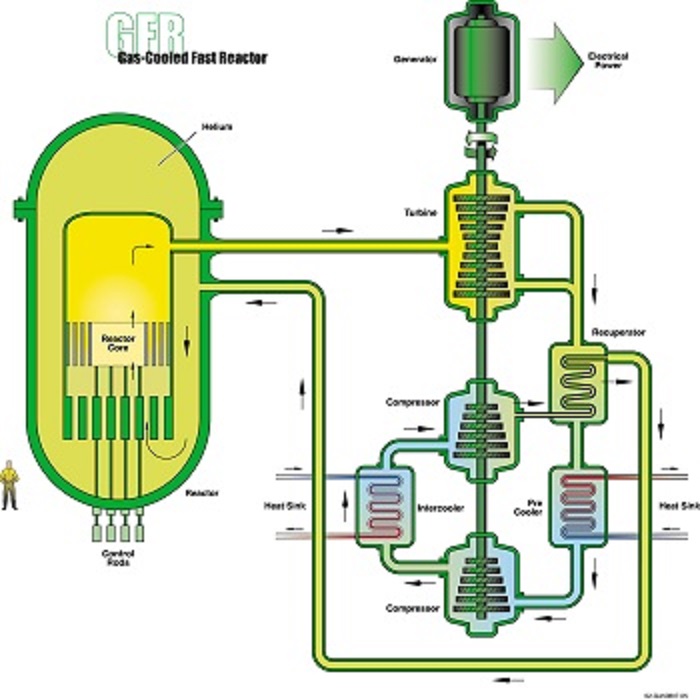
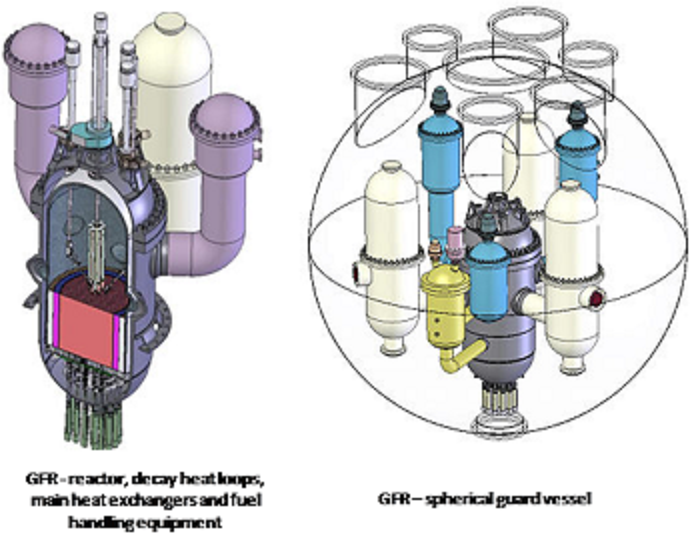
Gas-Cooled Fast Reactor (GFR)
The GFR system is a high-temperature (850C) helium-cooled fast-spectrum reactor with a closed fuel cycle. It combines the advantages of fast-spectrum systems for long-term sustainability of uranium resources and waste minimization (through fuel multiple reprocessing and fission of long-lived actinides), with those of high-temperature systems (high thermal cycle efficiency and industrial use of the generated heat, for hydrogen production for example).
This system is ideal for co-generation of electricity and hydrogen production.
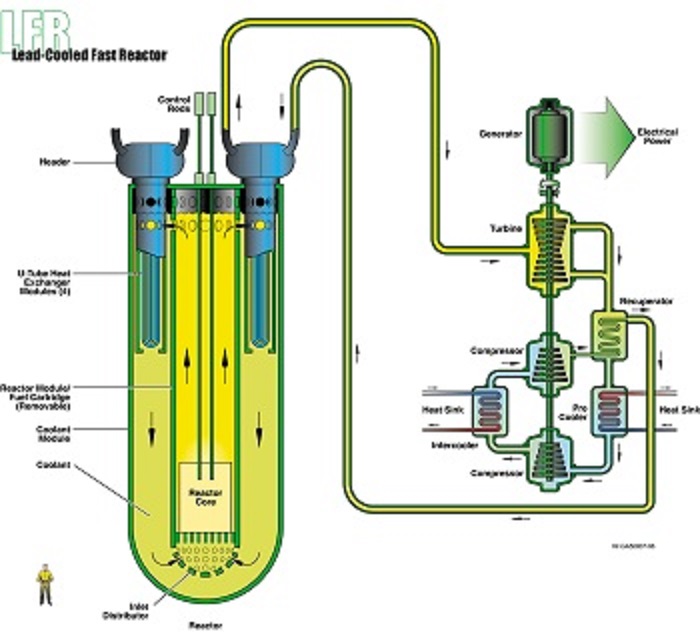
Lead-Cooled Fast Reactor (LFR)
a
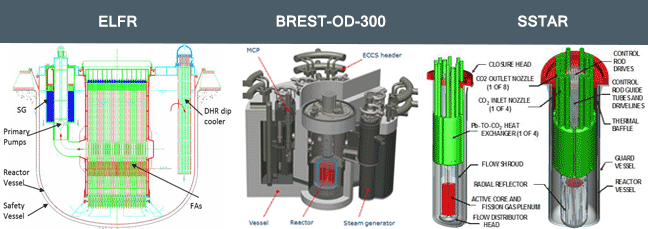
This reactor type would have multiple applications including production of electricity, hydrogen and process heat. System concepts represented in plans of the Generation IV International Forum (GIF) System Research Plan (SRP) are based on Europe’s ELFR lead-cooled system, Russia’s BREST-OD-300 and the SSTAR system concept designed in the US. Numerous additional LFR concepts are also under various stages of development in different countries including China, Russia, the USA, Sweden, Korea and Japan.
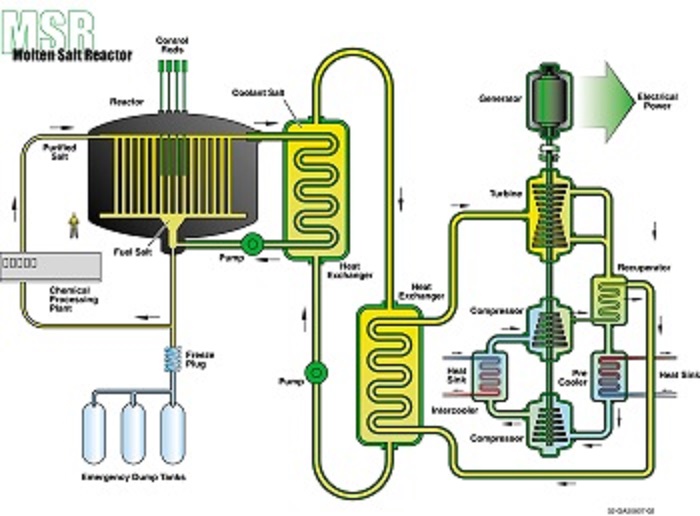
Molten Salt Reactor (MSR)
. The onsite fuel reprocessing unit using pyrochemistry allows breeding plutonium or uranium-233 from Thorium.
Compared with solid-fuel reactors, MSFR systems have lower fissile inventories, no radiation damage constraint on attainable fuel burn-up, no requirement to fabricate and handle solid fuel, and a homogeneous isotopic composition of fuel in the reactor. These and other characteristics give MSFRs potentially unique capabilities for actinide burning and extending fuel resources.
MSR developments in Russia on the Molten Salt Actinide Recycler and Transmuter (MOSART) aim to be used as efficient burners of transuranic (TRU) waste from spent UOX and MOX light water reactor (LWR) fuel without any uranium and thorium support and also with it. Other advanced reactor concepts are being studied, which use the liquid salt technology, as a primary coolant for Fluoride salt-cooled High-temperature Reactors (FHRs), and coated particle fuels similar to high temperature gas-cooled reactors.
More generally, there has been a significant renewal of interest in the use of liquid salt as a coolant for nuclear and non-nuclear applications. These salts could facilitate heat transfer for nuclear hydrogen production concepts, concentrated solar electricity generation, oil refineries, and shale oil processing facilities amongst other applications.
Supercritical-Water-Cooled Reactor (SCWR)
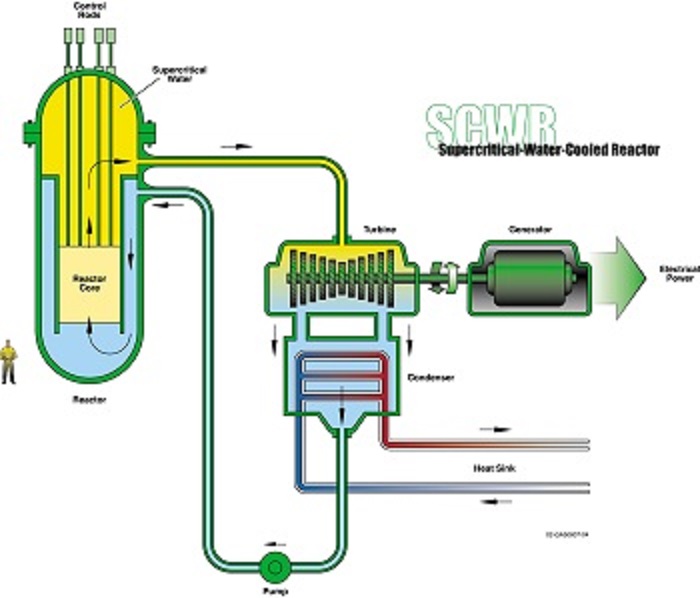
SCWRs are high temperature, high-pressure, light-water-cooled reactors that operate above the thermodynamic critical point of water (374°C, 22.1 MPa).
SCWR designs have unique features that offer many advantages compared to state-of the-art water-cooled reactors:
SCWRs offer increases in thermal efficiency relative to current-generation water-cooled reactors. The efficiency of a SCWR can approach 44% or more, compared to 34-36% for current reactors.
Reactor coolant pumps are not required. The only pumps driving the coolant under normal operating conditions are the feed water pumps and the condensate extraction pumps.
The steam generators used in pressurized water reactors and the steam separators and dryers used in boiling water reactors can be omitted since the coolant is superheated in the core.
Containment, designed with pressure suppression pools and with emergency cooling and residual heat removal systems, can be significantly smaller than those of current water-cooled reactors.
The higher steam enthalpy allows to decrease the size of the turbine system and thus to lower the capital costs of the conventional island.
There remains a number of challenges before this approach can be fully implemented, and one limiting factor is composite materials that can withstand high pressure, high temperature and high radiation at the same time.
Sodium-Cooled Fast Reactor (SFR)
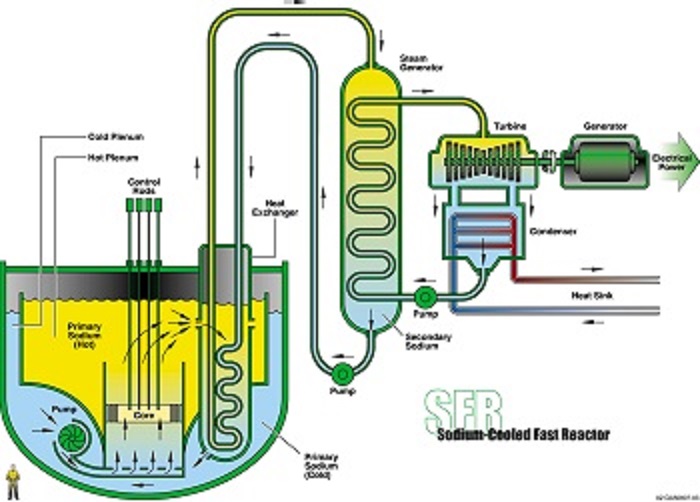
The SFR uses liquid sodium as the reactor coolant, allowing high power density with low coolant volume fraction and operation at low pressure. While the oxygen-free environment prevents corrosion, sodium reacts chemically with air and water and requires a sealed coolant system.
Plant size options under consideration range from small, 50 to 300 MWe, modular reactors to larger plants up to 1 500 MWe. The outlet temperature is 500-550°C for the options, which allows the use of the materials developed and proven in prior fast reactor programs.
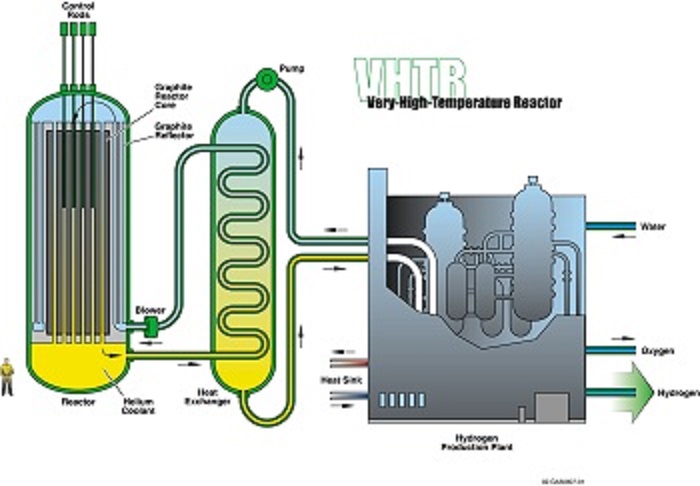
Very-High-Temperature Reactor (VHTR)
The VHTR is a next step in the evolutionary development of high-temperature gas-cooled reactors. It is a graphite-moderated, helium-cooled reactor with thermal neutron spectrum. It can supply nuclear heat and electricity over a range of core outlet temperatures between 700 and 950°C, or more than 1 000°C in future. The reactor core type of the VHTR can be a prismatic block core such as the Japanese HTTR, or a pebble-bed core such as the Chinese HTR-10.
The VHTR can support alternative fuel cycles such as U-Pu, Pu, MOX (Mixed Oxide fuel), U-Thorium.
Acts 16:16-40. In Philippi Paul and Silas were put in prison, but while singing praises to God their chains fell off, the Philippian Jailer, rather than killing himself asked “Sirs, what must I do to be saved?” And they answered, “Believe on the Lord Jesus Christ, and thou shalt be saved, and thy house.” Since Paul and Silas were Roman citizens they were asked to leave secretly, but they went to Lydia’s house instead. After that they departed.
2 Chronicles 3. Solomon did build the temple to man’s standard, six hands to a cubit. He even used gold nails instead of iron nails in the ceiling, far more gold than was called for in the tabernacle.
2 Chronicles 4 contains a listing of the temple furnishings.
2 Chronicles 5. The ark was brought into the Temple, and the glory of the LORD filled the Temple.