Matthew 22:34-46 The Pharisees tried to entrap Jesus by asking him which is the greatest commandment. Jesus answered with the first commandment and added another: “Love your neighbor as yourself.” Once more they tried to entrap him with the question: Whose son is the Christ? Jesus answered: “The Lord said unto my Lord, Sit thou on my right hand, till I make thine enemies thy footstool? If David then call him Lord, how is he his son?” That shut them up.
Deuteronomy 9, Israel’s rebellion is reviewed, but in spite of being a stiffnecked people doing abominations to the LORD like the Golden Calf, God in His mercy kept His promises.
Deuteronomy 10, take Two Tablets, Fear the LORD and circumcise your hearts, that is the Essence of the Law. Remember, you too were aliens in Egypt.
Psalm 22, of David. It is also called “The Crucifixion Psalm”. Read it and ponder.
In Matthew 22:1-33 Jesus continued to talk in parables. He was in Jerusalem, teaching about the Kingdom of Heaven and told the parable of the wedding banquet, from which we have the expression “many are called but few are chosen.” Continuing on, the Pharisees tried to entrap him with the question “is it legal to pay taxes to Caesar or not?” Jesus answered by the famous quote: “Give unto Caesar what is Caesar’s and to God what is God’s,” an early call to separation of Church and State. Jesus did not say “let the Romans do it”. The Sadducees also tried to entrap him with the riddle “if there is no resurrection and seven brothers have had a woman as his wife on after another, who would marry her in the resurrection?” Jesus answered with another, now made famous, saying: “God is not the God of the dead but of the living.”
Deuteronomy 7 promised that the Israelites would always be a Chosen People. God will drive out the people before them. When entering the land they must completely destroy all idols and false gods.
Deuteronomy 8. Remember the LORD your God, but if not you too will be destroyed.
Matthew 21:12-46. Jesus cleansed the Temple and threw out the money changers. The spiritual leaders were offended that people sang “Hosanna in the highest” at the triumphal entry, even that little children sang it. As an object lesson Jesus cursed a fig tree, the symbol of Israel, and it withered. The spiritual leaders questioned Jesus authority. Instead of giving an answer Jesus gave two parables, the one about the two sons and the parable about the wicked tenants. Moving on, Jesus quoted scripture by saying :The stone the builders rejected has become the cornerstone” meaning that the kingdom of God will be inherited by another people.
In Deuteronomy 6 Moses laid out The Greatest Commandment, he recommended the Israelites to wear phylacteries to keep them always in remembrance of the LORD and cautioned against disobedience. It is surprising how many of New Testament references there are to the Old testament Law; some are listed here.
Matthew 21:1-11 tells of Jesus’ triumphal entry into Jerusalem, and that event begins what is called the “holy week”. Jesus rode in to Jerusalem on an unbroken colt, the prophesied sign of the coming Messiah.
Deuteronomy 5. The Ten Commandments were enumerated a second time, the first time was in Exodus 20. The people were afraid of God’s presence, they were horrified but not in reverential fear.
Matthew 20:17-34. Jesus predicted his death. After that the mother of Zebedee’s sons asked Jesus to have her sons to be seated with Jesus in the kingdom of heaven, but Jesus answer was that is only for the Father to decide. The other disciples got angry, but Jesus admonished them all that the kingdom of heaven means to be a servant. The chapter ends with Jesus, out of compassion healed two blind men.
In Deuteronomy 4 God promised the people they will enter the promised land, but if they are disobedient they will be scattered all over the earth. Obedience means no idolatry “for the LORD, your God is a consuming fire, even a jealous God”. Three Cities of Refuge are mentioned.
In Matthew 20:1-16 Jesus told the parable of the workers in the vineyard, that God is always fair even when we don’t think so.
Deuteronomy 2 tells of the first 38 years of wandering in the the Desert. The generation entering the desert had died off and with the help of God King Sihon was Defeated.
Deuteronomy 3 describes how King Og was defeated and how the Israelites conquered the land East of Jordan, but Moses was forbidden to cross the Jordan and enter the Promised Land.
Matthew 19:13-30 contains some of the most important aspects of life. Here is a jewel: “Let the little children come to me…” After Jesus gave that lesson, a rich young ruler asked what good thing he must do to get eternal life. Jesus answered: “If thou wilt be perfect, go and sell that thou hast, and give to the poor, and thou shalt have treasure in heaven: and come and follow me.” This he could not do, so he sighed and walked away. Jesus then commented “It is easier for a camel to go through the eye of a needle than for a rich man to enter the Kingdom of God,” in other words, impossible. But cheer up, “with God all things are possible.” And God’s pecking order is not economic or based on power. Instead, sometimes “the first shall be last, and the last shall be first.” There are many idioms in the English language taken from the Bible. Yet the origin of these quotations are not allowed to be taught in public schools. Ponder that.
Deuteronomy 1 starts with the LORD’s command telling the Israelites to leave Horeb and enter Canaan. Leaders were appointed and spies sent out, but Israel refused to enter the land. The penalty for Israel’s rebellion was that no one would enter the promised land except Caleb and Joshua.
Matthew 19:1-12 is relatively short but contains some of the most important aspects of life, such as marriage and divorce. “What therefore God hath joined together, let no man put asunder.”
Ecclesiastes 8. Obey authorities for God’s Sake, and yes, this too is in Ecclesiastes: “Eat, drink and be merry.” It fits with the theme of vanity.
Psalm 19, of David. “This Psalm reflects, more than any other, the beauty and splendor of the Hebrew poetry found in the Psalter. C.S. Lewis wrote, ‘I take this to be the greatest poem in the Psalter and one of the greatest lyrics in the world.’” (VanGemeren)
Psalm 20, of David. The people’s prayer for the King is heard by the LORD. The most quoted part is: “ Some trust in chariots, and some in horses: but we will remember the name of the Lord our God.” The Lord saves, we pray for the King.
Psalm 21, of David. The New Testament references from Revelation 14 seems to fit. When I read the Psalm the battle hymn of the republic kept ringing in my ears.
Matthew 18:10-35. This chapter contains the parable of the lost sheep, which leads naturally into the subject of forgiveness, reconciliation and church discipline. Jesus also promised that “where two or three come together in my name, there am I with them”. The chapter ends with the parable of the unmerciful servant.
Numbers 33 is a reciting of Israel’s Journey from Egypt, and provides instructions on how the Israelites were to conquer Canaan.
Numbers 34, defines the Boundaries of Canaan and mentions all the leaders appointed to divide the land.
Numbers 35 defines the forty-two Cities for the Levites and their six Cities of Refuge.
Numbers 36 tells about the Inheritance of Zelophehad’s Daughters and why the Israelite women must marry within their tribe.
During the little ice age the earth was significantly colder than today, but there was special factors that led to this: The Maunder solar minimum and two super novas, one discovered in 1572 by Tycho Brave and the other in 1604 by Kepler.
I will beginthe time of industrialization with the invention of the steam engine 1775 by James Watt. While not the original inventor he improved it so much that it became common use for power generation. Up to that time people had depended on water and wind power and in a few cases tidal power. This increased the use of coal, which up to that point had been used exclusively for heating.
Since 1765 the global temperature of the earth has increased by about 1.4C and is expected to increase another tenth of a degree by 2050.
When global temperature increases 1.5 degrees and relative humidity stays the same there will be 10% more water vapor in the air. How much of the temperature rise is attributable to a 10% increase in water vapor?
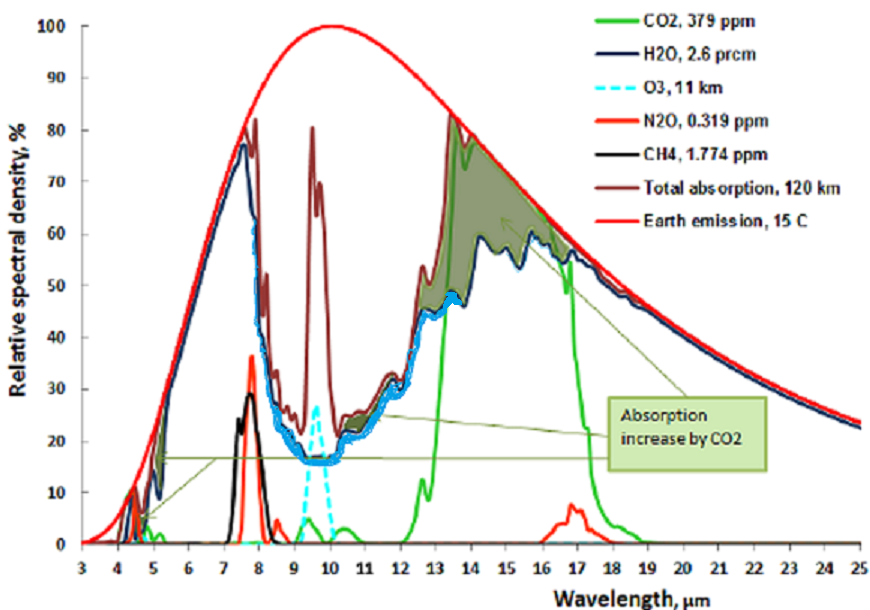
To answer that we must take a look at the greenhouse effect. Without it the earth would be an ice ball with an average temperature about 33C cooler than today. The earth can be considered a black body that obeys laws for black body radiation, the Stefan–Boltzmann law that states that the total energy radiation is proportional to the fourth power of the absolute temperature (Kelvin), so an increase in global temp from 13C t0 14.5C results in an increase of 2.11% in the total greenhouse effect (a smaller increase in the atmospheric window).
To sum it up: Since water vapor is fundamental I will count it first, and the effect of all the other greenhouse gases will be additional, remembering that the total absorption in any frequency band can never exceed 100% of available energy.The increase of absorption occurs in the atmospheric window, and in some bands of the incoming sunlight in the near infrared region. The bands are 0.7, 0.8, 0.9, 1.1, 1.4 and 1.9 μm. Together, they make up 90% of the greenhouse gas temperature rise, or 29.9 degree C. When global temperatures increase by 1,5 C there will be 10% more water water vapor assuming relative humidity will stay constant, there will be an additional 0.31 C temperature rise.
Total greenhouse effect 33 C, Greenhouse effect from water vapor is 29.9C
Increased water vapor greenhouse effect from 2.11 % increased black body emissions: 0.52C
Increased greenhouse effect from 10 % water vapor increase 0.31C